U.S. Energy Information Administration logo
Skip to sub-navigation
January 26, 2012

Domestic supply of liquid fuels projected to increase, resulting in fewer imports
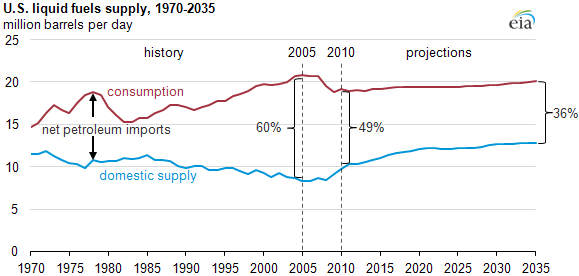
graph of U.S. liquid fuel supply, 1970-2035, as described in the article text
Source: U.S. Energy Information Administration, Annual Energy Outlook 2012 Early Release.
Download CSV Data

U.S. dependence on imported liquids declines through 2035 in the 2012 Annual Energy Outlook (AEO2012) Reference case projection, primarily as a result of growth in domestic oil production, an increase in biofuels use, and slower growth in consumption of transportation fuels. In this projection, net petroleum imports as a share of total U.S. liquid fuels supplied drop from 49% in 2010 to 36% in 2035.

Net petroleum imports are projected to make up a smaller share of total energy consumption in response to modest economic growth, increased efficiency, growing domestic oil production, and continued adoption of nonpetroleum liquids. Although not included in the Reference case, proposed fuel economy standards for future vehicles (model years 2017 through 2025) would further reduce projected liquids use and the need for imports.

Projections in the Annual Energy Outlook 2012 Reference case assume current laws and regulations remain generally unchanged throughout the projection period, thus serving as a starting point for analysis of energy policies. More highlights from the Reference case, as well as projections for several energy factors through 2035, are available in the AEO2012 Early Release Reference Case Overview and supporting materials.

Statistics
Analysis
Tools
Education
News

Petroleum & Other Liquids

Crude oil, gasoline, heating oil, diesel, propane, and other liquids including biofuels and natural gas liquids.

Natural Gas

Exploration and reserves, storage, imports and exports, production, prices, sales.

Electricity

Sales, revenue and prices, power plants, fuel use, stocks, generation, trade, demand & emissions.

Coal

Reserves, production, prices, employment and productivity, distribution, stocks, imports and exports.

Nuclear & Uranium

Uranium fuel, nuclear reactors, generation, spent fuel.

Renewable & Alternative Fuels

Includes hydropower, solar, wind, geothermal, biomass and ethanol.

EIA Survey Forms

Forms EIA uses to collect energy data including descriptions, links to survey instructions, and additional information.

Total Energy

Comprehensive data summaries, comparisons, analysis, and projections integrated across all energy sources.

U.S. States

State energy information, including overviews, rankings, data, and analyses.

International

International energy information, including overviews, rankings, data, and analyses.

Environment

Greenhouse gas data, voluntary reporting, electric power plant emissions.

Data Tools, Apps, & Maps

Tools to customize searches, view specific data sets, study detailed documentation, and access time-series data.

Open Data

EIA's free and open data available as API, Excel add-in, bulk files, and widgets

EIA Beta

Come test out some of the products still in development and let us know what you think!

Open Source Code

EIA's open source code, available on GitHub.

RSS Feeds

Subscribe to feeds for updates on EIA products including Today in Energy and What's New.