
California program encourages adoption of zero-emissions vehicles
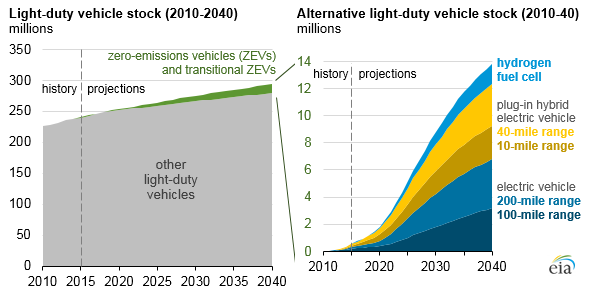
California’s Zero-Emission Vehicle (ZEV) program is expected to increase sales of electric, plug-in hybrid, and other alternative light-duty vehicles in the United States. The ZEV program is administered by the California Air Resources Board and affects model year 2018 and later vehicles, requiring automakers to earn credits for alternative fueled vehicles based on a percentage of their sales in California. So far, nine other states (Connecticut, Maine, Massachusetts, Rhode Island, Vermont, New Jersey, New York, Maryland, and Oregon) have adopted California’s ZEV program. Taken together, California and the nine other states that have adopted the program accounted for 28% of total U.S. sales of light duty vehicles in 2015. Analysis in EIA’s Annual Energy Outlook 2016 (AEO2016) looks at the ZEV program’s implications for vehicle sales and energy consumption.
The ZEV sales requirement is administered through credits that are earned for selling specific types of vehicles. The value of the credits for vehicles sold within each of the following categories depends on certain vehicle characteristics including, for example, the electric driving range of electric vehicles:
- Full zero-emission vehicles (full ZEVs), such as battery-only electric or hydrogen fuel cell vehicles
- Transitional ZEVs, such as plug-in hybrid electric or hydrogen internal combustion engine vehicles
- Advanced Technology Partial-ZEVs, such as gasoline- or diesel-electric hybrid, compressed natural gas, or methanol fuel cell vehicles
- Conventional Partial-ZEVs, which are considered extremely clean conventional vehicles
Partial and transitional ZEVs have lower credit values than full ZEVs. For example, sales of hybrid electric and plug-in hybrid electric vehicles yield fewer credits than sales of battery-only powered electric vehicles.
The required credits are calculated as a percentage of an automaker’s conventional light-duty vehicle sales. The total percentage requirement starts at 4.5% for model year 2018 sales and increases to 22% for model year 2025 sales. Full ZEVs must make up 16% of the required credits by model year 2025, which encourages the sale of vehicles powered by electricity or hydrogen fuel cells.
The AEO2016 Reference case projects sales and energy consumption of these vehicles assuming compliance with the ZEV program in all adopting states. Even though the program is based in California, national sales are affected as more alternative light-duty vehicle models become available as a response to the mandate. Taken together, California and the nine other states that have adopted the program accounted for an estimated 39% of national light-duty electric and plug-in hybrid vehicle sales in 2015.
The AEO2016 Reference case projects that by 2025, full ZEVs and transitional ZEVs will make up 6% of national light-duty vehicle sales and about 2% of the total light-duty vehicle stock. With the increased stock, light-duty vehicles are projected to account for about half a percent of national electricity demand by 2025. After full implementation of the ZEV program in 2025, market penetration and energy consumption for electric, plug-in hybrid, hydrogen, and other alternative vehicles is projected to continue to grow through 2040.
Principal contributor: David Stone