
U.S. gasoline prices are on the rise heading into Labor Day
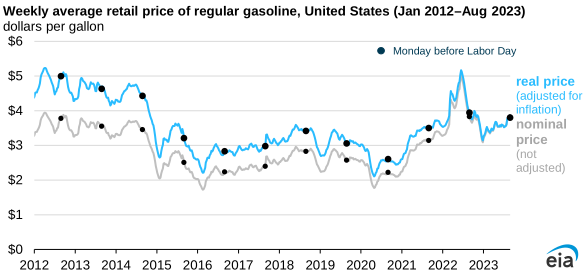
Note: Weekly data reflect U.S. average regular gasoline retail price for all formulations. Real price is calculated using Consumer Price Index from BLS.
On the Monday before the Labor Day weekend, August 28, 2023, the retail price of regular gasoline averaged $3.81 per gallon (gal) across the United States. Over the past five weeks, oil production cuts by Saudi Arabia, low U.S. gasoline inventories, and announced refinery maintenance in the Northeast have increased the regular gasoline retail price by 6%, or 22 cents/gal.
According to our Gasoline and Diesel Fuel Update, after adjusting for inflation (real terms), retail gasoline prices going into this Labor Day weekend were 4%, or 14 cents/gal, lower than last year.
Recent production cuts by Saudi Arabia and other OPEC+ members are putting upward pressure on crude oil prices (the largest component of the gasoline price). Production cuts by OPEC+ members in April did not affect crude oil prices much because concerns about slowing economic growth drove expectations that crude oil demand would remain steady or decline. This time, successive rounds of cut announcements beginning in June and recent data showing improving economic conditions in the United States are raising the price of crude oil.
Ahead of this Labor Day, Hurricane Idalia is affecting U.S. Gulf Coast production and pipeline facilities. Hurricane-induced facility closures can have uncertain effects on the retail price of gasoline, and the scale of the impact relates to the duration and severity of the closures.
Limited gasoline supplies have also contributed to higher gasoline prices. Refinery outages caused by extreme weather and refinery maintenance originally scheduled for last year have kept U.S. gasoline inventories below the previous five-year average since March 2022. Most recently, we expect planned maintenance for Irving Oil’s refinery (320,000 barrels per day [b/d]) in Saint John, New Brunswick, and Monroe Energy’s refinery (185,000 b/d) in Trainer, Pennsylvania, which will run from mid-September to mid-November, to keep gasoline supplies limited, especially in the Northeast. The East Coast is the highest-consuming gasoline market in the United States, but it has relatively little refinery capacity.
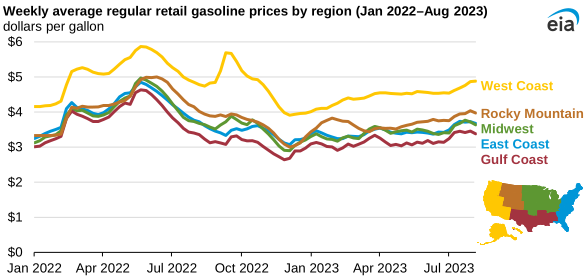
U.S. gasoline prices vary regionally, reflecting local supply and demand conditions, different fuel specifications required by state laws, and taxes. Regional gasoline prices are usually the highest on the West Coast due to the region’s limited connections with other major refining centers (including the Gulf Coast), tight local supply and demand conditions, and requirements for gasoline specifications that make gasoline more costly to manufacture. West Coast prices as of August 28 were $4.88/gal, up 2%, or 10 cents/gal, from the same time last year. The Rocky Mountains region faces similar logistical constraints as the West Coast, although overall supply and demand in the region are both lower. Rocky Mountain gasoline retail prices averaged $3.98/gal, a 1%, or 4 cents/gal, decrease over 2022.
The Gulf Coast accounted for 54% of the country’s total refining capacity as of January 2023, and it produces more gasoline than it consumes. As a result, the price of gasoline on the Gulf Coast is often the lowest in the United States. On August 28, the average retail gasoline price for the Gulf Coast was $3.38/gal, up 1%, or 2 cents, from the same time last year.
On the East Coast, retail gasoline prices were $3.64/gal on August 28, down 1%, or 4 cents, compared with the same time last year. Midwest prices decreased 1%, or 4 cents, to $3.68/gal.
Principal contributor: Alex de Keyserling