
U.S. wind energy production tax credit extended through 2021
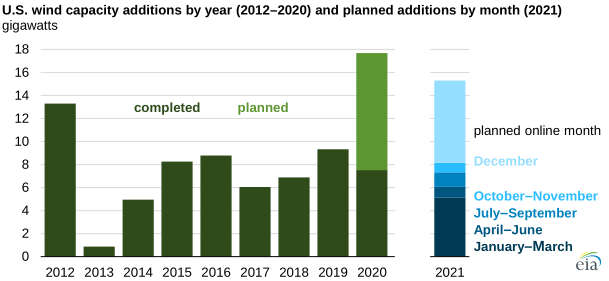
The timing and magnitude of wind turbine installations in the United States are often driven by tax incentives. The U.S. production tax credit (PTC), a per-kilowatthour (kWh) credit for electricity generated by eligible renewable sources, was first enacted in 1992 and has been extended and modified in the years since. At the end of December 2020, Congress extended the PTC at 60% of the full credit amount, or $0.018 per kWh ($18 per megawatthour), for another year through December 31, 2021. In 2020, the credit was 60% of the full credit amount. Under the new PTC legislation, qualifying wind projects must begin construction by December 31, 2021.
Based on previous PTC legislation, wind projects that started construction in 2016 qualify for 100% of the full credit amount. After 2016, the percentage decreases by 20% per year from 2017 through 2019; facilities starting construction in 2019 qualify for 40% of the full credit amount.
Wind projects can receive the tax credit based on either the year the project begins operation or the year in which 5% of the total capital cost for the project has been spent and construction has begun. This 5% down method, known as safe harboring, allows wind developers to receive the PTC at a given year’s level, provided they complete construction no more than four calendar years after the calendar year that construction began.
To help address construction delays related to COVID-19, the Internal Revenue Service (IRS) issued guidance in May 2020 allowing projects that began construction in 2016 or 2017 an additional year for construction, giving them five years to come online instead of four.
U.S. wind capacity totaled 112 gigawatts (GW) as of November 2020, the latest data available in the U.S. Energy Information Administration’s (EIA) Electric Power Monthly. According to plans announced by project developers and grid operators and compiled in EIA’s Preliminary Monthly Electric Generator Inventory, another 10 GW was expected to be added in December, bringing the annual 2020 total to 21 GW. December’s planned additions will be confirmed as operational in EIA’s survey results released in late February.
If all planned additions are confirmed, 2020 will be a record year for wind installations, far surpassing the previous record of 13.2 GW added in 2012. The record level of annual capacity additions in 2020 was driven by developers scheduling project completion in time to qualify for the full-valued PTC from 2016. Wind capacity additions tend to be relatively high in years when the PTC is set to expire, such as in 2012 and 2020.
In 2021, project developers expect 12.2 GW of wind capacity to come online, of which they expect 7.2 GW (59%) to come online in December. December has historically been the month with the most wind capacity additions.
Expected capacity additions discussed in this article are based on projects reported to EIA through surveys and reported in EIA’s Preliminary Monthly Electric Generator Inventory. The recent release of this report includes generators that became operational as of November 2020. EIA has not updated the expected additions in December 2020 since the extension of the PTC, as part of the Consolidated Appropriations Act.
Principal contributor: Richard Bowers
Tags: production/supply, wind, capacity