
U.S. average retail gasoline prices in 2019 were slightly lower than in 2018
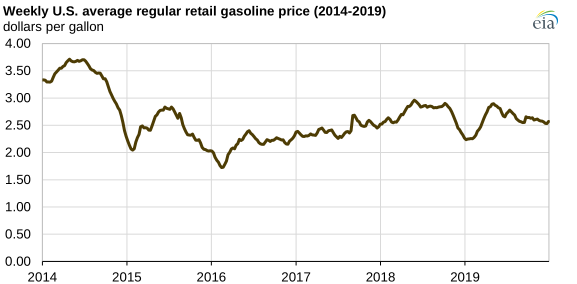
U.S. regular retail gasoline prices averaged $2.60 per gallon (gal) in 2019, 11 cents/gal (4%) lower than in 2018. Gasoline prices rose steadily during the first quarter of the year, rising from $2.24 on January 7 to $2.90/gal on May 6, before gradually declining through the rest of the year. Because the cost of crude oil accounts for about 52% of retail gasoline’s final cost, the price of gasoline generally follows movements in crude oil prices, which followed a similar price path during 2019.
Each Monday, in its Gasoline and Diesel Fuel Update, the U.S. Energy Information Administration (EIA) collects and publishes data on retail gasoline and diesel fuel prices for 10 cities, 9 states, 5 regions, and the United States as a whole. Variations in gasoline prices across the country reflect differences in gasoline specifications, state and local taxes, and supply and demand balances in regional markets.
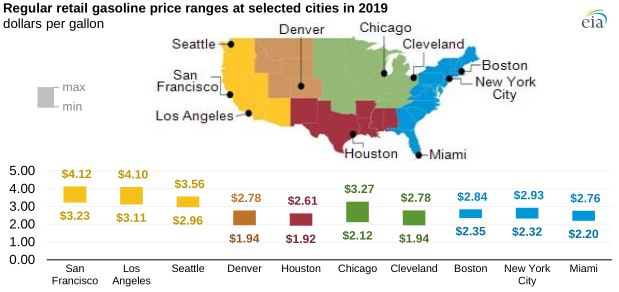
East Coast (Boston, New York City, and Miami). East Coast gasoline moved within a range of $2.22/gal and $2.79/gal, during 2019, and prices in Boston and New York City peaked at the start of the summer driving season on May 6 at $2.84/gal and $2.93/gal, respectively. Prices in New York City averaged $2.62/gal during 2019, $2.59/gal in Boston, and $2.47/gal in Miami. Except for a brief two-month period between April and May, prices in Miami were consistently lower than in New York City and Boston.
Midwest (Chicago and Cleveland). The Midwest covers a large geographic area consisting of many semi-connected markets and widely dispersed refining centers. Prices in Chicago were higher than prices in Cleveland and higher than the Midwest regional average in 44 of 52 weeks during 2019. Gasoline prices throughout the Midwest averaged $2.49/gal during 2019, which is 12 cents lower than the national average. Average prices for the entire Midwest region moved within a range of $2.00/gal to $2.77/gal during the year.
Gulf Coast (Houston). Gulf Coast retail gasoline prices tend to be the lowest in the country, and the region has had the country’s lowest price every year for the past 20 years. The region is home to half of all U.S. refining capacity and produces substantially more gasoline than it consumes. For 45 weeks in 2019, retail gasoline prices in Houston were the lowest of the 10 cities for which EIA collected data. Average gasoline prices for the entire Gulf Coast region moved within a range of $1.89/gal to $2.58/gal during the year.
Rocky Mountains (Denver). The Rocky Mountain’s gasoline demand centers are geographically dispersed and are separated from sources of supply by mountain ranges and large expanses of wilderness and rural lands, which contribute to higher prices in the region. For 2019, the region’s average gasoline prices were the second highest in the country for 39 weeks, but they were also the second lowest for 9 weeks—a duality that reflects the region’s relatively low gasoline consumption and divergent local circumstances. Average gasoline prices for the entire Rocky Mountains region moved within a range of $2.17/gal to $2.98/gal during the year.
West Coast (Los Angeles, San Francisco, and Seattle). Gasoline prices on the West Coast tend to be higher than in other parts of the country because of the region’s limited interconnections with other major refining centers and because of gasoline specifications that make it more costly to manufacture. As a result, average gasoline prices in the West Coast have been the nation’s highest for the past 20 years.
West Coast gasoline prices in 2019 were especially elevated because of a combination of local refinery outages and attacks on Saudi Arabian oil facilities. These events led to average prices in California rising higher than the $4.00/gal mark for only the second time since 2014. Of the 10 cities for which EIA collects data, retail gasoline prices in San Francisco were the highest for all but three weeks in 2019. Average gasoline prices for the entire West Coast region moved within a range of $2.91/gal to $3.71/gal during the year.
Principal contributor: Jesse Barnett
Tags: prices, gasoline, liquid fuels, oil/petroleum