
Shale gas production drives world natural gas production growth
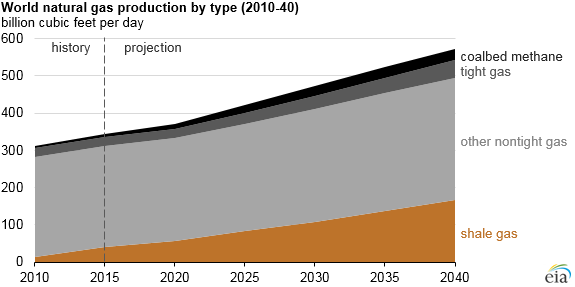
In the U.S. Energy Information Administration's International Energy Outlook 2016 (IEO2016) and Annual Energy Outlook 2016 (AEO2016), natural gas production worldwide is projected to increase from 342 billion cubic feet per day (Bcf/d) in 2015 to 554 Bcf/d by 2040. The largest component of this growth is natural gas production from shale resources, which grows from 42 Bcf/d in 2015 to 168 Bcf/d by 2040. Shale gas is expected to account for 30% of world natural gas production by the end of the forecast period.
Although currently only four countries—the United States, Canada, China, and Argentina—have commercial shale gas production, technological improvements over the forecast period are expected to encourage development of shale resources in other countries, primarily in Mexico and Algeria. Together, these six countries are projected to account for 70% of global shale production by 2040.
In the United States, shale gas production accounted for more than half of U.S. natural gas production in 2015 and is projected to more than double from 37 Bcf/d in 2015 to 79 Bcf/d by 2040, which is 70% of total U.S. natural gas production in the AEO2016 Reference case by 2040.
Several AEO2016 side cases illustrate the effect of technological improvements on cost and productivity. Shale gas production in 2040 is projected to be 50% higher under the High Oil and Gas Resources and Technology case, reaching 112 Bcf/d, while in the Low Oil and Gas Resources and Technology case, production is projected to be 50% lower than the Reference case, reaching 41 Bcf/d.
Canada has been producing shale gas since 2008, reaching 4.1 Bcf/d in 2015. Shale gas production in Canada is projected to continue increasing and to account for almost 30% of Canada's total natural gas production by 2040.
China has been among the first countries outside of North America to develop shale resources. In the past five years, China has drilled more than 600 shale gas wells and produced 0.5 Bcf/d of shale gas as of 2015. Shale gas is projected to account for more than 40% of the country's total natural gas production by 2040, which would make China the second-largest shale gas producer in the world after the United States.
Argentina's commercial shale gas production was just 0.07 Bcf/d at the end of 2015, but foreign investment in shale gas production is increasing. Pipeline infrastructure in Argentina is adequate to support current levels of shale gas production, but it will need to be expanded as production grows. Current shortages of specialized rigs and fracturing equipment are expected to be resolved, and shale production is projected to account for almost 75% of Argentina's total natural gas production by 2040.
Algeria's production of both oil and natural gas has declined over the past decade, which prompted the government to begin revising investment laws that stipulate preferential treatment for national oil companies in favor of collaboration with international companies to develop shale resources. Algeria has begun a pilot shale gas well project and developed a 20-year investment plan to produce shale gas commercially by 2020. Algerian shale production is projected to account for one-third of the country's total natural gas production by 2040.
Mexico is expected to gradually develop its shale resource basins after the recent opening of the upstream sector to foreign investors. At present, Mexico is expanding its pipeline capacity to import low-priced natural gas from the United States. Mexico is expected to begin producing shale gas commercially after 2030, with shale volumes contributing more than 75% of total natural gas production by 2040.
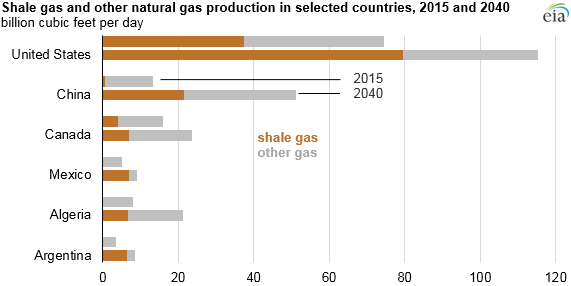
Note: Other gas includes coalbed methane, tight gas and other (nontight) gas.
Principal contributors: Faouzi Aloulou, Victoria Zaretskaya
Tags: Canada, China, international, Mexico, natural gas, production/supply, shale, United States