
LNG imports make up increasing share of Colombia’s natural gas supply
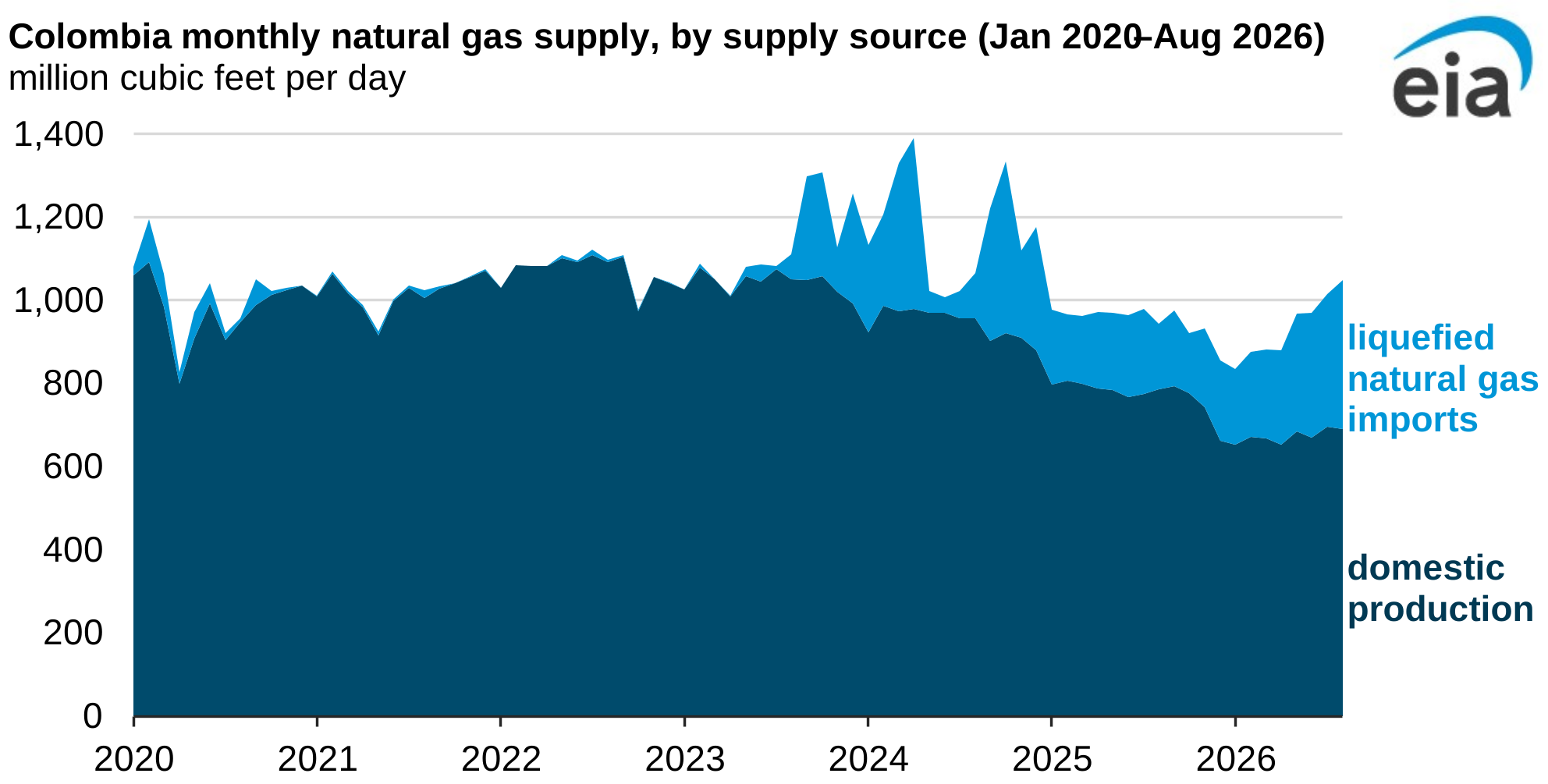
Colombia is importing more liquefied natural gas (LNG) as domestic production continues to fall. A potential drought this fall and winter could limit the availability of hydroelectric generation and boost the country’s demand for natural gas power generation. Colombia’s government has declared a national disaster in anticipation of a drought resulting from an expected strong El Niño.
Average annual marketed natural gas production in Colombia decreased from 1,070 million cubic feet per day (MMcf/d) in 2022 to 772 MMcf/d in 2025, according to Gestor del Mercado de Gas Natural en Columbia (BEC). Between January and August 2026, production declined further, averaging 673 MMcf/d. The fields that produce most of Colombia’s natural gas—specifically Cusiana, Cupiagua, Pauto Sur, and the offshore Guajira fields—have been declining since 2022, with no large discoveries developed to replace them. Proved reserves fell 39% to 1.7 trillion cubic feet between 2022 and 2025, according to the National Hydrocarbons Agency.
As production declined, LNG imports grew. LNG imports accounted for a record 31% of Colombia’s monthly natural gas supply in July 2026, according to data from BEC, Colombia’s gas market administrator.
Despite the increased reliance on imports, Colombia only has one operating LNG import terminal, SPEC LNG, which is located near Cartagena on the Caribbean coast. Work is under way to expand the terminal’s capacity to be online in 2026 and as early as end of October, according to Promigas. A new project, the Buenaventura LNG terminal, is targeting to startup by November 2026. In addition, the Puerto Bahia LNG Terminal and Ballenas LNG Terminal could start operations next year.
On June 11, the National Oceanic and Atmospheric Administration (NOAA) announced that an El Niño formed in the tropical Pacific. In October 2026, NOAA's Climate Prediction Center issued an El Niño Advisory, reporting that the El Niño continues to strengthen and that there’s a greater than 83% chance of a strong to very-strong event through the first quarter of 2027. NOAA considers an El Niño event to be strong when ocean temperatures in the Niño-monitored region of the Pacific Ocean are equal to or exceed 1.5 degrees Celsius, and a very strong event occurs when ocean temperatures equal or exceed 2.0 degrees Celsius.

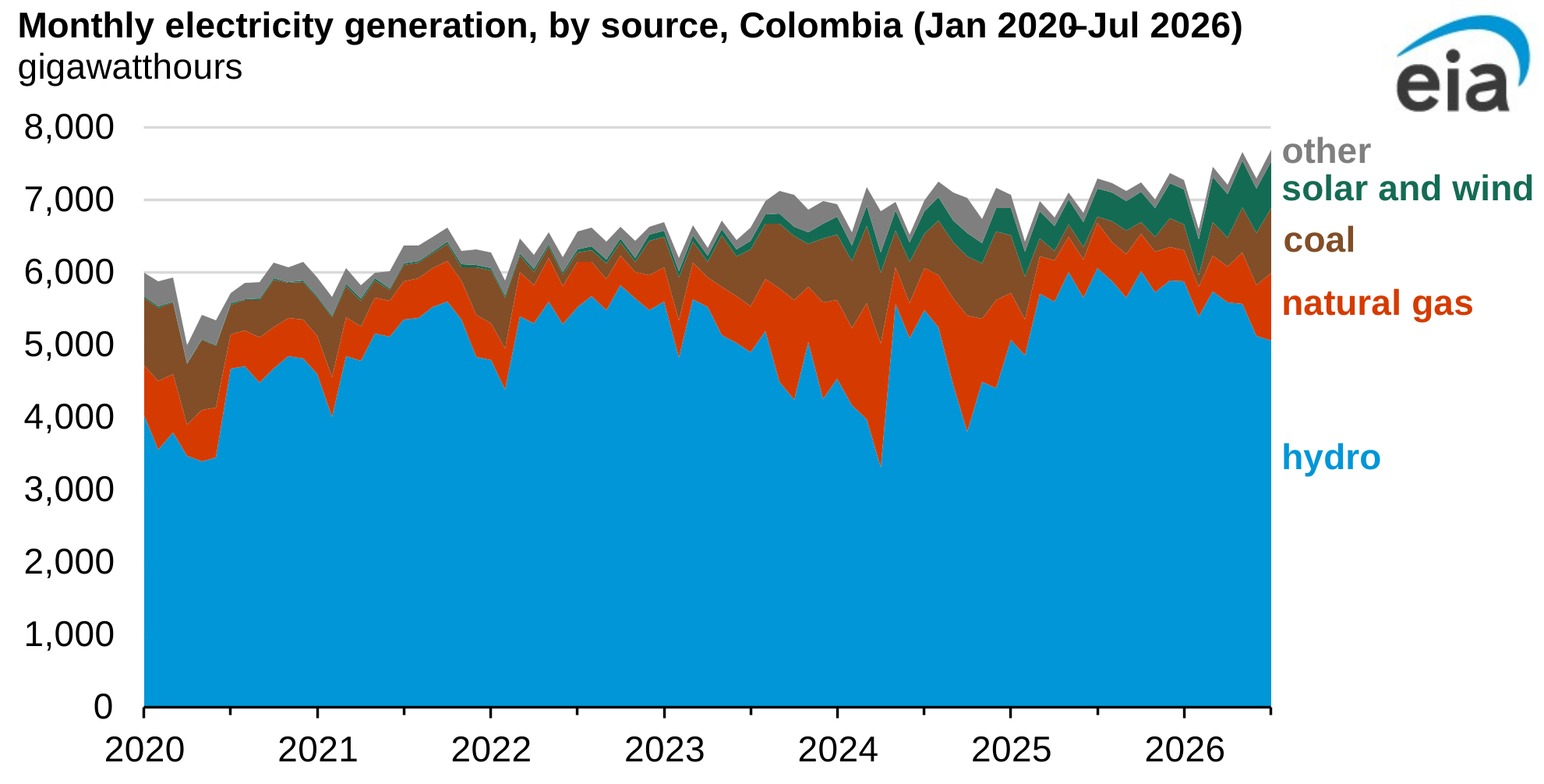
El Niño typically brings drier-than-normal weather to northern South America from December through February, according to NOAA’s Climate Prediction Center, reducing the availability of hydropower. Natural gas consumption in Colombia’s electric power sector spiked in 2023 and 2024 when there was a strong El Niño weather pattern. In 2025, hydropower supplied 81% of the country’s electricity, natural gas supplied 8%, and coal supplied 4%. By comparison, hydropower made up 55% of the country’s electricity in March 2024, the last strong El Niño year, while natural gas-fired generation rose to 22% and coal-fired generation rose to 15%.
The share of hydropower electricity generation fell to 66% in July 2026 while coal and natural gas each accounted for 12% of electricity generation. If a strong El Niño persists, natural gas will likely play a larger role in electricity generation.
Principal contributors: Eulalia Munoz Cortijo, Justine Barden