
China continues rapid growth of nuclear power capacity
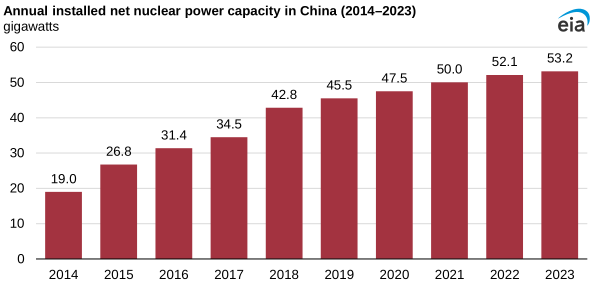
In the past 10 years, more than 34 gigawatts (GW) of nuclear power capacity were added in China, bringing the country’s number of operating nuclear reactors to 55 with a total net capacity of 53.2 GW as of April 2024. An additional 23 reactors are under construction in China. The United States has the largest nuclear fleet, with 94 reactors, but it took nearly 40 years to add the same nuclear power capacity as China added in 10 years.
Despite rapid capacity growth in 2022, nuclear power made up only about 5% of China’s cumulative power generation that year. Nuclear power accounts for about 18% of the electricity generation mix in the United States.
China implemented a long-term strategy in 2011 for nuclear power development to meet its electricity demand and to address environmental concerns. Given growing electricity demand over the last decade, China’s utilities have increased development of all types of electricity generation. However, coal remains China’s largest electricity generation source and is the source of much of the country's air pollution. More carbon dioxide has been emitted in China than in any other country since 2006. Although nuclear power generation is a zero carbon-emitting technology, coal-fired power plants have significantly lower upfront capital costs and shorter construction times. Coal-fired capacity increased by 19.5 GW in China in 2022, bringing its total coal-fired capacity to 1,089 GW, despite the country's pledge to reduce coal consumption. In 2022, China had just over 52 GW of installed nuclear power capacity.
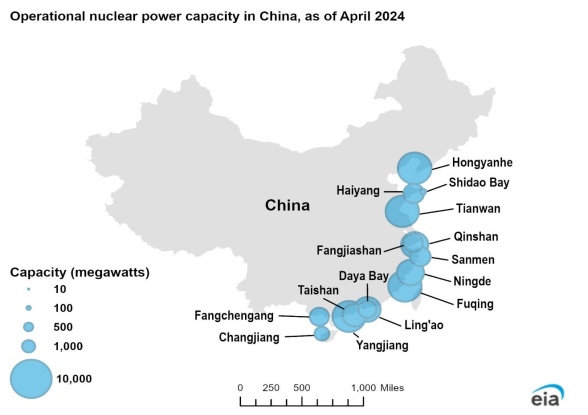
China’s nuclear fleet is concentrated near population centers in the eastern part of the country along the coast of the Pacific Ocean. Nuclear reactors are located from the Liaoning province in the north to the Hainan province in the south. The country’s nuclear fleet consists mostly of pressurized water reactors (PWR), including the U.S. Westinghouse designed AP1000s, each with a capacity of 1,157 megawatts (MW), and the French Orano European Power Reactors, each with a capacity of 1,660 MW.
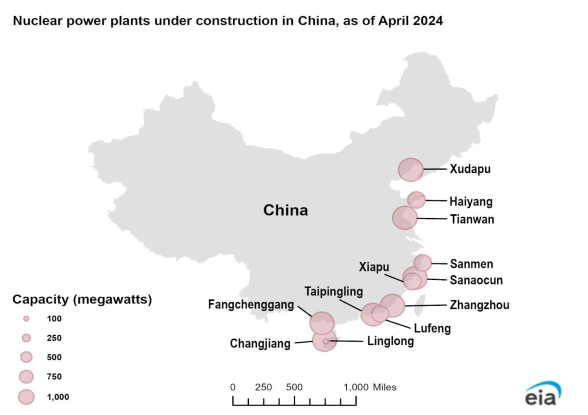
We estimate that the 23 reactors currently under construction in China will add about 23.7 GW to China’s existing nuclear power capacity over the next decade. The reactor unit designs are mostly PWR. China is also building a Linglong-1 ACP100 reactor, a domestically designed small modular reactor based on AP1000 technology.
More information about energy in China is available in our China Country Analysis Brief.
Principal contributors: Slade Johnson, Jonathan Russo
Tags: nuclear, generation, electricity, China, map, CAB (Country Analysis Brief), capacity