
New Renewable Fuel Standard volume targets facilitate renewable natural gas production
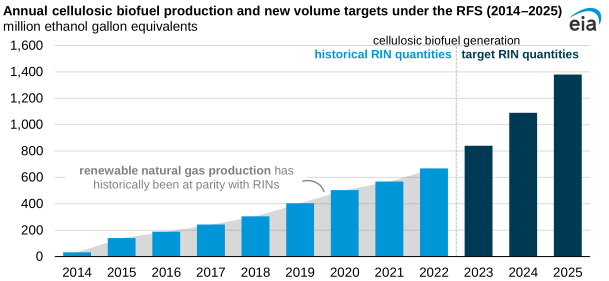
On June 21, 2023, the U.S. Environmental Protection Agency (EPA) announced a final rule that established biofuel volume requirements and standards for cellulosic biofuel for 2023–25 as part of the Renewable Fuel Standard (RFS) program. The cellulosic biofuel category primarily applies to Renewable Natural Gas (RNG), a form of natural gas made from biogas. The rule increases volume targets for cellulosic biofuel by 25% to 840 million gallons in 2023, by 29% to 1.09 billion gallons in 2024, and by 33% to 1.38 billion gallons in 2025 compared with the previous target.
RFS is a federal program that requires gasoline and diesel producers to incorporate renewable fuels into the nation’s transportation fuel supply. EPA issues RFS rulemakings with volume requirements for certain renewable fuel categories and sets those volumes through annual renewable volume obligations (RVO). The EPA generates Renewable Identification Numbers (RINs) when certified fuels are produced, and producers can trade RINs with other market participants.
The annual volume targets for cellulosic biofuel help increase RNG production in the United States. RNG is produced by treating and purifying biogas generated from landfills, farms, waste-water facilities, and food-waste facilities. Unlike biogas, RNG is fully interchangeable with fossil-based natural gas and can be injected into natural gas pipelines or used to fuel natural gas vehicles. Nearly all RINs related to RNG production are in the cellulosic biofuel category, according to 2022 EPA data, and RNG production is responsible for 99% of the total cellulosic biofuel RINs generated.
Because the RNG produced to meet volume targets for cellulosic biofuel must be used as a transportation fuel, RNG’s share of natural gas consumed as vehicle fuel is significant. In 2022, RNG production that qualified for cellulosic biofuel RINs totaled 55 billion cubic feet (Bcf), approximately 84% of the nearly 64 Bcf of all natural gas used as transportation fuel in the United States, based on data from EPA and EIA’s Natural Gas Annual.
Although the share of RFS-derived RNG used in vehicles has grown, that volume is still a small share of total U.S. natural gas consumption. RNG production accounted for nearly 0.2% of total natural gas consumption in 2022.
Principal contributors: Jonathan Inbal, Stephen York