
EIA projects global energy consumption will outpace efficiency gains in most cases
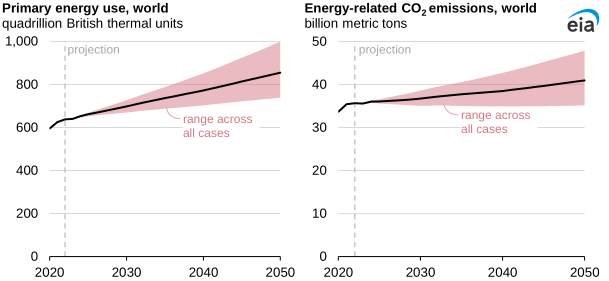
In our International Energy Outlook 2023 (IEO2023), we project that global energy-related CO2 emissions will increase by 2050 in a number of IEO2023 cases as global population growth and higher living standards push growth in energy consumption beyond advances in energy efficiency.
In all IEO2023 cases, we expect global primary energy consumption to increase through 2050. Our expectations of global population growth, increased regional manufacturing, and higher living standards indicate that global energy consumption will grow faster than advances in energy efficiency. Non-fossil fuel-based resources, including nuclear and renewables, produce more energy through 2050, but in most of the IEO2023 cases we examined, that growth is not sufficient to reduce global energy-related CO2 emissions under current laws and regulations.
In our IEO2023, we explore long-term world energy trends and present an outlook for energy markets through 2050. We use different scenarios, called cases, to understand how varying assumptions about technological advancement and economic growth affect energy trends. The IEO2023 Reference case—which serves as a baseline, or benchmark—and six side cases consider only the laws and regulations adopted through March 2023. The six side cases in IEO2023 explore differing assumptions of economic growth, crude oil prices, and technology costs.
U.S. projections in IEO2023 are the published projections in the Annual Energy Outlook 2023 (AEO2023), which assumed that U.S. laws and regulations as of November 2022 remain unchanged.
Some key takeaways from our IEO2023 include:
Increasing population and income offset the effects of declining energy and carbon intensity on emissions.
In all IEO2023 cases, global energy consumption increases, with the fastest growth in the residential and industrial sectors. Global consumption of liquid fuels increases through 2050, and industrial applications, such as chemical production, account for the fastest growth in liquid fuels consumption. Economic growth and increased disposable income increase demand for transportation in all IEO2023 cases. Although electric vehicles gain a larger share of the global transportation fleet, reducing transportation sector petroleum consumption, the industrial sector offsets those declines as its share of petroleum and other liquid fuels consumption rises.
The shift to renewables to meet growing electricity demand is driven by regional resources, technology costs, and policy.
Across IEO2023 cases, global electric-power generating capacity increases by a range of 50% to 100%, and electricity generation increases by 30% to 76% by 2050, depending on the IEO2023 case. Zero-carbon technologies account for most of the growth in both global capacity and generation. Electricity generation from renewables and nuclear could provide as much as two-thirds of global electricity generation by 2050, according to the projections. Battery storage capacity grows significantly in all IEO2023 cases, increasing from less than 1% of global power capacity in 2022 to a range of 4% to 9% of global power capacity by 2050, depending on the case.
Energy security concerns hasten a transition from fossil fuels in some countries, although they drive increased fossil fuel consumption in others.
Energy trade of fossil fuels will continue to evolve as emerging economies demand more energy and the world continues to adapt to current geopolitical events. In nearly all IEO2023 cases, energy production from zero-carbon technologies grows faster than from fossil fuels, but that dynamic varies from region to region. The Middle East and North America increase natural gas production and exports to meet growing demand, and Western Europe and Asia remain natural gas importers in all IEO2023 cases. Energy demand from China, India, Southeast Asia, and Africa will motivate major crude oil and natural gas producers to keep producing.
Principal contributor: Michelle Bowman