
World’s longest-operating solar thermal facility is retiring most of its capacity
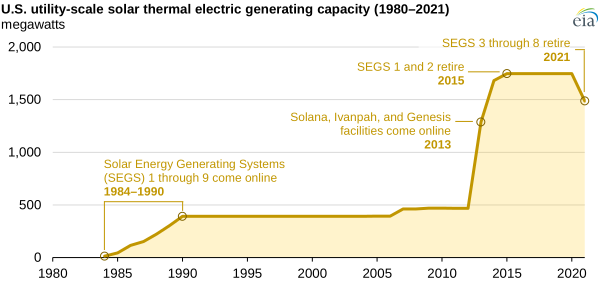
Note: SEGS 1 and SEGS 2 were replaced by photovoltaic systems Sunray 2 and Sunray 3, respectively, in 2017 after being decommissioned. They appear in EIA data as Sunray 2 and Sunray 3.
The Solar Energy Generating Systems (SEGS) facility in California’s Mojave Desert retired five of its solar plants (SEGS 3 through 7) in July 2021 and plans to retire a sixth (SEGS 8) in September 2021, based on information submitted to EIA and published in our Preliminary Electric Generator Inventory. After SEGS 8 is retired, only one solar thermal unit at SEGS will remain operating (SEGS 9). SEGS, which began operating in 1984, is the world’s longest-operating solar thermal power facility.
Solar thermal power plants use mirrors to focus sunlight onto a receiver, which absorbs and converts the sunlight into thermal energy (heat). The heat is used to drive a turbine, which produces electricity. The SEGS units are parabolic trough concentrating solar thermal power (CSP) systems, meaning that parabolic (u-shaped) mirrors capture and concentrate sunlight to heat synthetic oil in a central tube, which then boils water to create steam. The steam drives the turbine, generating electricity.
The 356-megawatt (MW) SEGS facility was originally made up of nine solar thermal plants. SEGS 1 and 2 were retired in 2015 and replaced with two solar photovoltaic (PV) farms, Sunray 2 and Sunray 3. SEGS 3 through 7 (each with 36 MW of capacity) came online from 1986 to 1988. SEGS 8 and 9 (each with 88 MW of capacity) came online in 1989 and 1990, respectively.
Solar thermal plants account for a relatively small share of utility-scale U.S. solar electric generating capacity. As of June 2021, the United States had about 52,600 MW of utility-scale solar capacity. Of that total, 3.3% was solar thermal; the remaining 96.7% was utility-scale solar PV.
Although solar capacity in the United States is increasing rapidly, most of the capacity additions in recent years have been solar PV. About 42,000 MW of utility-scale PV capacity was added to the U.S. power grid between 2015 and June 2021; no additional solar thermal capacity has been added since the Crescent Dunes plant came online in 2015.
Based on data that developers and power plant owners have reported to EIA, one utility-scale solar thermal plant is planned to come online in the next five years in the United States: Arizona’s 200-MW La Paz Solar Tower. According to trade press and announced projects, several CSP projects are planned or are in development in other countries.
Principal contributor: Singfoong “Cindy” Cheah
Tags: generation, electricity, retirements, power plants, solar