
Natural gas expected to remain most-consumed fuel in the U.S. industrial sector
Updated March 12, 2018 at 10:00 a.m. to clarify the definition of the industrial sector, which includes lease and plant fuel as well as liquefaction fuel for exports.
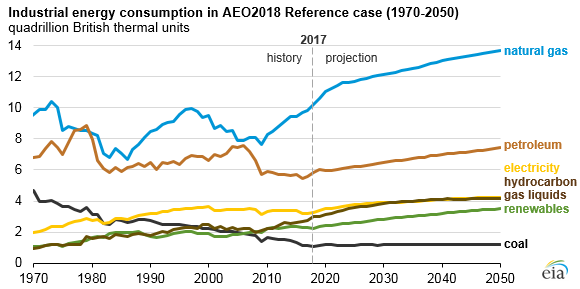
EIA expects a 40% increase in natural gas consumed in the U.S. industrial sector, from 9.8 quadrillion British thermal units (Btu) in 2017 to 13.7 quadrillion Btu in 2050, according to the Annual Energy Outlook 2018 (AEO2018) Reference case. By 2020, total industrial natural gas consumption will surpass the previous record set in the early 1970s, according to the AEO2018 Reference case.
The U.S. industrial sector consumes more natural gas than any other sector, surpassing electric power in 2017 and the combined residential and commercial sectors in 2010. The industrial sector, as discussed here, includes natural gas used in production operations (lease and plant fuel) and natural gas used for liquefaction of natural gas for export. About 40% of the increase in industrial natural gas consumption from 2017 through 2030 is lease and plant fuel and liquefaction fuel, which, by 2030, represent 22% of total industrial natural gas consumption.
In 2017, about two-thirds of total industrial natural gas consumption was consumed for heat or power applications—either for industrial processes, such as in furnaces, or for onsite electricity generation. Several industries including bulk chemicals, food, glass, and metal-based durables used natural gas for 40% or more of their heat or power applications in 2017.
EIA expects that these industries will continue to use about the same proportion of natural gas for heat or power applications through 2050 because of the cost associated with fuel switching. Industrial fuel switching often involves changing manufacturing processes, which requires substantial capital investment in new equipment.
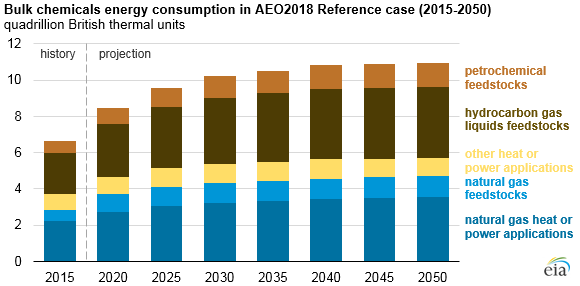
As the largest natural gas consumer in the industrial sector, the bulk chemicals industry consumed 3.1 quadrillion Btu of natural gas in 2017, or the equivalent of about 3.0 trillion cubic feet. The bulk chemicals industry includes production of organic chemicals (including petrochemicals), inorganic chemicals, resins, and agricultural chemicals.
In the AEO2018 Reference case, increases in the bulk chemicals industry’s consumption of natural gas outpaces overall growth in the industrial sector through 2050, with 51% growth compared with the sector average of 40%. Most natural gas in the bulk chemicals industry is used for heat or power applications, but about 25% of bulk chemical natural gas consumption is used for feedstocks in agricultural chemicals (i.e., fertilizer) and methanol production.
Natural gas feedstock is only used for agricultural chemicals and methanol, but hydrocarbon gas liquids (HGL) can be used as feedstock for many basic organic chemicals such as ethylene and propylene, which are used in the production of plastics.
Most HGL production is recovered at natural gas processing plants from raw natural gas streams with high proportions of hydrocarbons other than methane. EIA projects that natural gas produced in the Appalachian and Permian basins will account for most of the growth in HGL production through 2050.
Principal contributor: Kelly Perl