U.S. Energy Information Administration logo
Skip to sub-navigation
September 28, 2011

Renewable energy shows strongest growth in global electric generating capacity
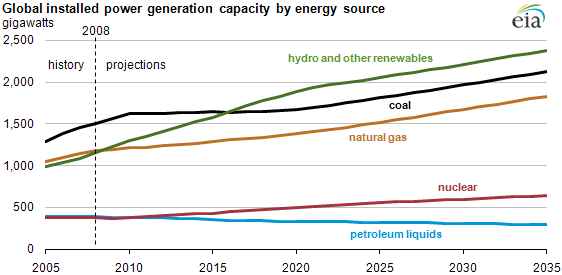
graph of global installed generation capacity by energy source, as described in the article text
Source: U.S. Energy Information Administration, International Energy Outlook 2011.
Download CSV Data

The U.S. Energy Information Administration's International Energy Outlook 2011 (IEO2011) projects that the amount of global hydroelectric and other renewable electric generating capacity will rise 2.7% per year through 2035, more than any other electricity generating source (see chart above). The IEO2011 also projects that China and India will lead the way in adding hydroelectric and renewable electric generating capacity.

Among renewables, installed hydroelectric power capacity is expected to increase more than other renewable sources between 2008 and 2035. However, installed solar power capacity sees the largest growth rate over the projection period, expanding 8.3% per year, based on EIA's IEO2011 released on September 19, followed by 5.7% for wind, 3.7% for geothermal, 2.0% for hydropower, and 1.4% for other renewables such as wood waste, landfill gas, and agricultural byproducts.
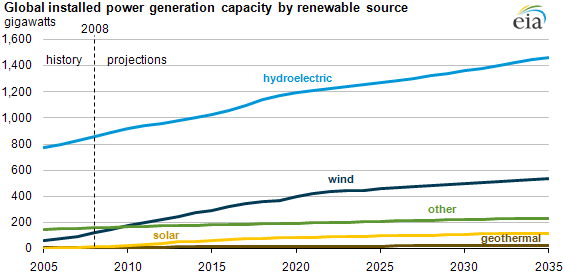
graph of global installed generation capacity by renewable source , as described in the article text
Source: U.S. Energy Information Administration, International Energy Outlook 2011.
Download CSV Data

Long-term annual growth rates for global installed generating capacity are 2.0% for nuclear, 1.6% for natural gas-fired power plants, and 1.3% for coal, according to the IEO2011. The report estimates installed capacity of power plants running on petroleum products will fall by 1.0% a year, as higher oil costs and climate change concerns encourage a switch to cheaper and cleaner generating fuels.

The IEO2011 did not reflect changes in the nuclear policies of some countries following damage to Japan's Fukushima Daiichi nuclear power plant this past spring.

In addition to having the highest annual growth rate, renewable energy sources are expected to account for the biggest share of total installed electric generating capacity by 2035, nearly a third at 2,372 gigawatts. Renewables are also the fastest growing energy source for actual electricity production, increasing 3.1% per year.

However, because renewable generators have average utilization rates well below those for other types of capacity, the level of renewable generation is expected to remain below that of coal, the dominant generation source, and other fuels.

Statistics
Analysis
Tools
Education
News

Petroleum & Other Liquids

Crude oil, gasoline, heating oil, diesel, propane, and other liquids including biofuels and natural gas liquids.

Natural Gas

Exploration and reserves, storage, imports and exports, production, prices, sales.

Electricity

Sales, revenue and prices, power plants, fuel use, stocks, generation, trade, demand & emissions.

Coal

Reserves, production, prices, employment and productivity, distribution, stocks, imports and exports.

Nuclear & Uranium

Uranium fuel, nuclear reactors, generation, spent fuel.

Renewable & Alternative Fuels

Includes hydropower, solar, wind, geothermal, biomass and ethanol.

EIA Survey Forms

Forms EIA uses to collect energy data including descriptions, links to survey instructions, and additional information.

Total Energy

Comprehensive data summaries, comparisons, analysis, and projections integrated across all energy sources.

U.S. States

State energy information, including overviews, rankings, data, and analyses.

International

International energy information, including overviews, rankings, data, and analyses.

Environment

Greenhouse gas data, voluntary reporting, electric power plant emissions.

Data Tools, Apps, & Maps

Tools to customize searches, view specific data sets, study detailed documentation, and access time-series data.

Open Data

EIA's free and open data available as API, Excel add-in, bulk files, and widgets

EIA Beta

Come test out some of the products still in development and let us know what you think!

Open Source Code

EIA's open source code, available on GitHub.

RSS Feeds

Subscribe to feeds for updates on EIA products including Today in Energy and What's New.