
U.S. energy demand slows except for industrial, commercial sectors
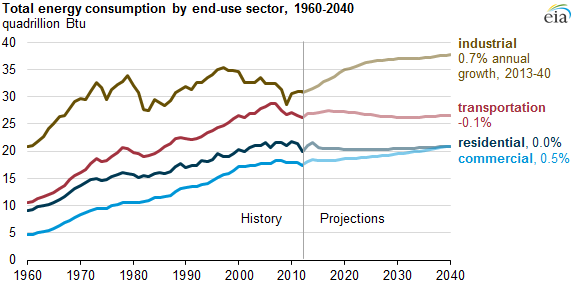
U.S. energy consumption has slowed recently and is not anticipated to return to growth levels seen in the second half of the 20th century. EIA's Reference case projections in the Annual Energy Outlook 2015 (AEO2015) show that domestic consumption is expected to grow at a modest 0.3% per year through 2040, less than half the rate of population growth. Energy used in homes is essentially flat, and transportation consumption will decline slightly, meaning that energy consumption growth will be concentrated in U.S. businesses and industries.
Near-zero growth in energy consumption is a recent phenomenon, and there is substantial uncertainty about the main drivers of consumption as the United States continues to recover from the latest economic recession and resumes more normal economic growth. EIA's analysis in the AEO2015 includes several cases with various assumptions about macroeconomic growth, world oil prices, and domestic energy resource availability.
Increases in energy consumption are mostly related to economic activity, and U.S. industrial and commercial enterprises are projected to increase output more rapidly than countervailing influences from improved technologies. Existing policies also can moderate energy use. Energy intensity, measured as the amount of energy per unit of output, does continue to decline during the projection period. Nonetheless, industrial energy consumption still rises by 0.7% per year through 2040, while commercial consumption rises 0.5% per year in the AEO2015 Reference case.
Declines in energy consumption tend to result from the adoption of energy efficient technologies (often affected by policy measures) and larger, structural changes in the economy. Although the residential and transportation sectors are different in the ways they consume energy, energy consumption in these sectors through 2040 is projected to remain below historical levels.
Most of the major energy-consuming equipment and appliances in U.S. homes and apartments have been covered by federal energy efficiency standards since the mid-1990s. As this equipment can often last for decades, the United States is only now reaching a period in which most appliances were manufactured and installed in an era when these efficiency standards were in place. Residential consumption has also declined as the population has shifted toward warmer climates, reducing the need for space heating. The corresponding increase in energy for space cooling is much less than energy for heating, thus reducing overall residential energy consumption.
The transportation sector has also seen consumption declines from energy efficiency and structural effects, with policy playing a large supporting role. Corporate average fuel economy standards for light-duty vehicles have been in place since the late 1970s, and similar standards for heavy-duty vehicles and trucks have been in place since the early 1980s. These standards, combined with less travel in response to technological and social factors, have reduced transportation energy consumption in recent years and are expected to continue holding transportation consumption nearly flat in the coming decades. Gasoline consumption, which accounted for 58% of transportation consumption in 2013, falls 21% by 2040 to 47% of total transportation energy consumption, while other transportation fuels such as diesel and jet fuel increase slightly.
Principal contributor: Jim Turnure