
Reduced water supply forecast affects hydropower outlook in Pacific Northwest
Note: Click to enlarge.
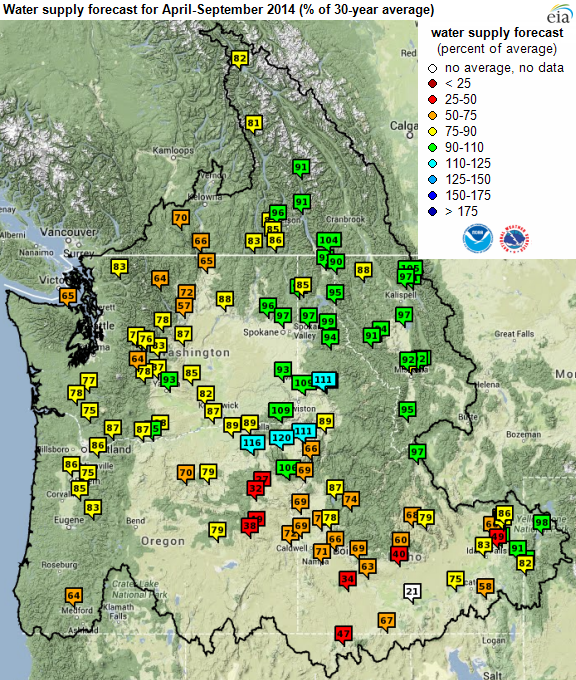
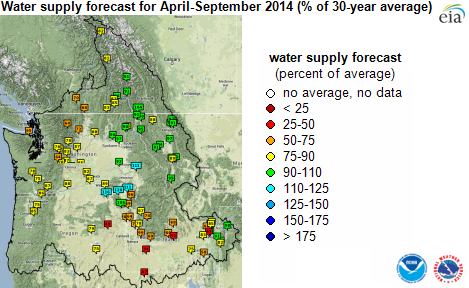
The Northwest River Forecast Center (a unit of the Department of Commerce) released on January 8 its first water supply projection of 2014 for the Pacific Northwest. The forecast indicates a below-normal runoff, as compared to the 30-year average (1981-2010), for a majority of the observation stations in the region. The map above shows observation stations throughout the watershed region of the Pacific Northwest. Forecasts for the percent-of-normal water supply for each station are indicated by color: above normal (blue), near normal (green and yellow), or below normal (orange and red).
The Pacific Northwest is home to the largest concentration of hydroelectric capacity in the country. Because water supply and the subsequent hydroelectric generation can vary widely from year to year, these forecasts are closely monitored. Reduced generation not only affects the immediate area; it can also affect neighboring regions, including California, that import hydropower from the Pacific Northwest. Water supply in California, as discussed in yesterday's Today in Energy article, is also extremely low.
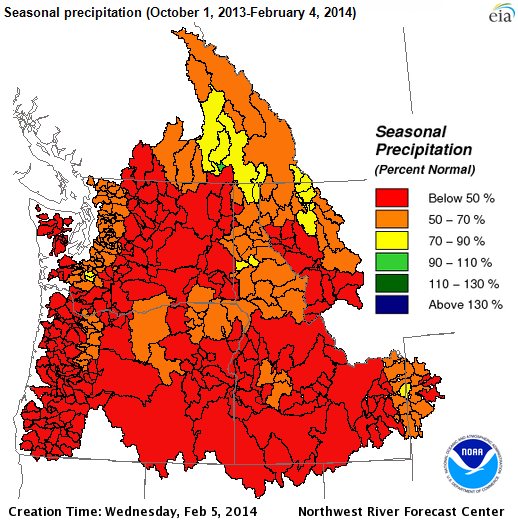
Precipitation for the hydrological year that began last October has been below 70% of normal levels throughout most of the Northwest, with the middle-to-lower Snake River basin in southeast Washington experiencing a particularly large precipitation deficit.
Hydroelectric supply can have implications for the dispatch of other generators (such as wind turbines, thermal generators, and the Columbia nuclear station) in the Pacific Northwest, where four states (Washington, Oregon, Idaho, and Montana) host 35% of U.S. hydroelectric capacity. The level of hydroelectric output in this region can also greatly influence regional wholesale power prices. Absent an abundant supply of hydroelectric output, wholesale power prices may be increasingly determined by the cost of natural gas generation in the region.
Principal contributor: Michelle Bowman
Tags: California, electricity, forecasts/projections, hydroelectric, map, Oregon, states, Washington, weather