
Extending investment tax credits through 2050 increases U.S. solar generation by 10%
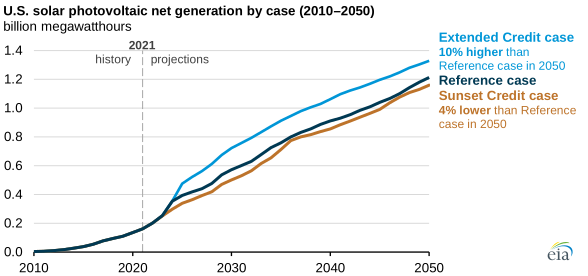
Extending investment tax credits (ITC) and production tax credits (PTC) through 2050 for renewable electricity generation increases annual U.S. solar generation by 10%, according to our alternative policy analysis, Annual Energy Outlook 2022: Extended and Sunset Tax Credit Cases. Long-term availability of federal tax credits provides an incentive for more small-scale distributed generation in homes and commercial buildings as well as utility-scale electricity generation from renewable sources, especially solar photovoltaic (PV).
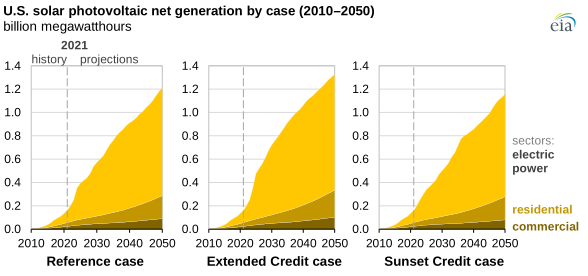
Federal ITCs and PTCs offset utilities' renewable technology installation costs and installation costs for distributed generation technologies in commercial and residential buildings. These credits gradually phase down or end entirely, also called sunsetting, depending on the sector and technology.
In the Sunset Credit case, sunsetting tax credits by 2023—which is just a few years earlier than in the Reference case—reduces projected annual solar generation by 4% in 2050. Solar generation accounts for 21% of total electricity generation in 2050, a nearly 1.0 trillion kilowatthour increase over the projection period.
Sunsetting these tax credits earlier has the largest effect on the commercial sector. We project 11% less commercial sector solar PV generation in 2050 in the Sunset Credit case than in the Reference case. Removing these renewable energy incentives reduces long-term investment in utility-scale and building-sited distributed solar generation.
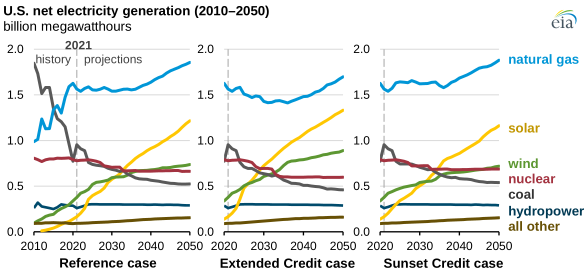
In the Extended Credit case, annual solar generation accounts for 25% of electricity generation across all U.S. sectors in 2050, a 1.2 trillion kilowatthour increase from 2021. Across all sectors, in the Reference, Sunset Credit, and Extended Credit cases, solar generation becomes the largest source of renewable generation by 2050, surpassing both hydroelectricity and wind.
Our analysis also explores how sunsetting policies earlier or extending them later can affect long-term electricity generation and capacity from combined-heat-and-power plants (CHP), wind, hydropower, geothermal, and biomass sources, which are all also eligible for the ITC. In the commercial and industrial sectors, CHP capacity and generation grows fastest in the Extended Credit case, and natural gas is the largest fuel source of CHP generation across all cases.
Our full report explores the effects of several policy adjustments, including extensions and early sunsetting of policies such as building energy efficiency incentives as well as the ITC and PTC. Otherwise, we keep assumptions about weather, growth in housing stocks and commercial floorspace, macroeconomic activity, and other drivers of energy use consistent with the Reference case.
Principal contributor: Courtney Sourmehi