
Nearly 90% of U.S. households used air conditioning in 2020
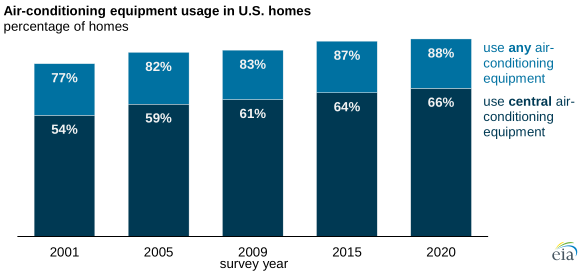
According to the most recent results from the 2020 Residential Energy Consumption Survey, 88% of U.S. households use air conditioning (AC). Two-thirds of U.S. households use central AC or a central heat pump as their main AC equipment.
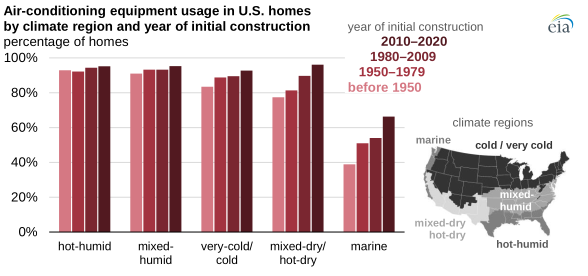
In 2020, the Midwest Census Region and South Census Region had the highest percentages of households using AC, at 92% and 93%, respectively. The lowest percentage of households using AC was 73% in the West Census Region; this census region includes households in several climate areas, such as the marine climate region along the Pacific Coast, where residential AC use was 49%.
Although central AC units are the primary equipment type used in most of the United States, 50% of Northeast households primarily use individual AC units. Individual AC units include window and wall units, mini-splits, and portable units.
Note: Climate regions are based on the U.S. Department of Energy’s Building America program.
RECS data show that newer homes are more likely to use AC in most climate regions. Nationally, 83% of homes built before 1950, and 93% of homes built between 2010 and 2020 used AC. The greatest difference in AC use among old and new housing is in the marine climate region, where only 39% of homes built before 1950 used AC, and 66% of homes built between 2010 and 2020 used AC. The only climate region that did not show a significant difference in AC usage across initial household construction periods was the hot-humid region in the southeastern United States.
Apartments were the least likely housing type to use AC equipment. Apartments in smaller buildings (2–4 units) had an AC usage rate of 80%, while apartments in larger buildings (5+ units) had an AC usage rate of 85%. By comparison, 90% of single-family detached homes used AC equipment. Households that do not use AC are more likely to be renters rather than owners.
The 2020 RECS collected data on household energy use from 18,496 households, the largest responding sample in the program’s history. Respondents completed the survey using self-administered web or mail questionnaires during late 2020 and early 2021. In addition to data on AC, the initial 2020 RECS results include estimates on types of fuels used and their end uses, structural and geographic characteristics, lighting, appliances, electronics, space heating, water heating, demographic characteristics, and household energy insecurity. In the coming months, we will release results for all 50 states and the District of Columbia.
Principal contributors: Ross Beall, Bill McNary