
EIA expects record liquid fuels inventory builds in early 2020, followed by draws
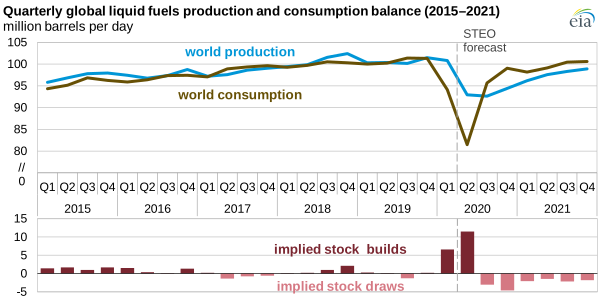
As mitigation efforts to contain the 2019 novel coronavirus disease (COVID-19) pandemic continue to lead to rapid declines in petroleum consumption around the world, the production of liquid fuels globally has changed more slowly, leading to record increases in the amount of crude oil and other petroleum liquids placed into storage in recent months. In its May Short-Term Energy Outlook (STEO), the U.S. Energy Information Administration (EIA) expects global inventory builds will be largest in the first half of 2020. EIA estimates that inventory builds rose at a rate of 6.6 million barrels per day (b/d) in the first quarter and will increase by 11.5 million b/d in the second quarter because of widespread travel limitations and sharp reductions in economic activity.
After the first half of 2020, EIA expects global liquid fuels consumption to increase, leading to inventory draws for at least six consecutive quarters and ultimately putting upward pressure on crude oil prices that are currently at their lowest levels in 20 years.
As with the March and April STEO, EIA’s forecast reductions in global oil demand arise from three main drivers: lower economic growth, less air travel, and other declines in demand not captured by these two categories, largely related to reductions in travel because of stay-at-home orders. Based on incoming economic data and updated assessments of lockdowns and stay-at-home orders across dozens of countries, EIA has further lowered its forecasts for global oil demand in 2020 in the May STEO. The STEO is based on macroeconomic projections by Oxford Economics (for countries other than the United States) and by IHS Markit (for the United States).
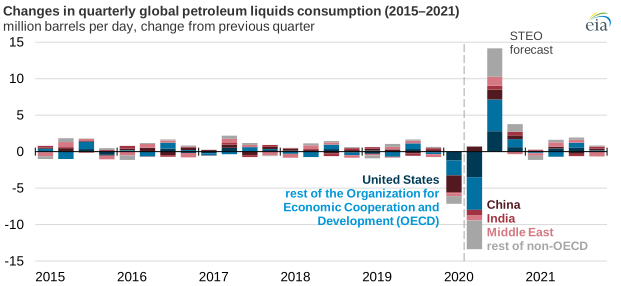
In the May STEO, EIA forecasts global liquid fuels consumption will average 92.6 million b/d in 2020, down 8.1 million b/d from 2019. EIA forecasts both economic growth and global consumption of liquid fuels to increase in 2021 but remain lower than 2019 levels. Any lasting behavioral changes to patterns in transportation and other forms of oil consumption once COVID-19 mitigation efforts end, however, present considerable uncertainty to the increase in consumption of liquid fuels, even if gross domestic product (GDP) growth increases.
Members of the Organization of the Petroleum Exporting Countries (OPEC) and partner countries (OPEC+) agreed to new production cuts in early April that will remain in place throughout the STEO forecast period ending in 2021. EIA assumes OPEC members will mostly adhere to announced cuts during the first two months of the agreement (May and June) and that production compliance will relax later in the forecast period as stated production cuts are reduced and global oil demand begins growing.
EIA forecasts OPEC crude oil production will fall to less than 24.1 million b/d in June, a 6.3 million b/d decline from April, when OPEC production increased following an inconclusive meeting in March. If OPEC production declines to less than 24.1 million b/d, it would be the group’s lowest level of production since March 1995. The forecast for June OPEC production does not account for the additional voluntary cuts announced by Saudi Arabia’s Energy Ministry on May 11.
EIA expects OPEC production will begin increasing in July 2020 in response to rising global oil demand and prices. From that point, EIA expects a gradual increase in OPEC crude oil production through the remainder of the forecast and for production to rise to an average of 28.5 million b/d during the second half of 2021.
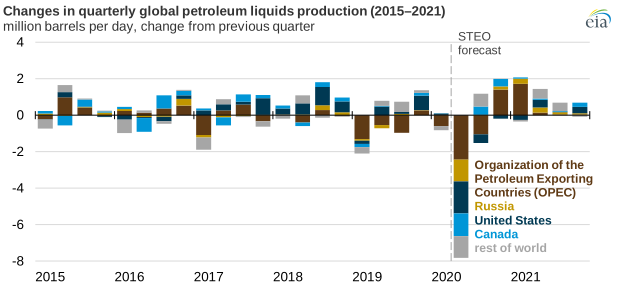
EIA forecasts the supply of non-OPEC petroleum and other liquid fuels will decline by 2.4 million b/d in 2020 compared with 2019. The steep decline reflects lower forecast oil prices in the second quarter as well as the newly implemented production cuts from non-OPEC participants in the OPEC+ agreement. EIA expects the largest non-OPEC production declines in 2020 to occur in Russia, the United States, and Canada.
Principal contributor: Hannah Breul