U.S. Energy Information Administration logo
Skip to sub-navigation
May 1, 2018

U.S. crude oil production efficiency continues to improve
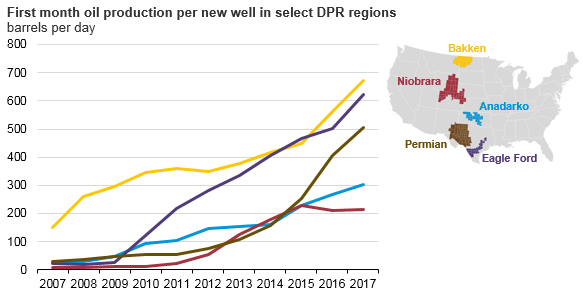
first month oil production per new well in select DPR regions, as explained in the article text
Source: U.S. Energy Information Administration, Drilling Productivity Report

U.S. tight oil production increased in 2017, accounting for 54% of total U.S. crude oil production, in part because of the increasing productivity of new wells. Since 2007, the average first full month of oil production from new wells in regions tracked by EIA’s Drilling Productivity Report (DPR) has generally increased. These growing initial production rates have helped tight oil production to increase despite slowdowns in drilling activity when oil prices fell.
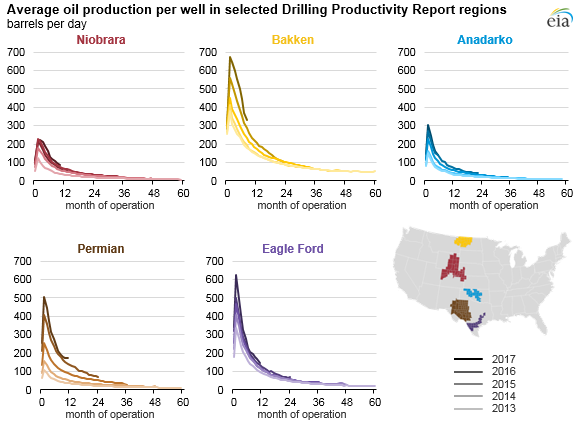
average oil production per well in selected DPR regions, as explained in the article text
Source: U.S. Energy Information Administration, Drilling Productivity Report

The average new well in each DPR region in 2017 produced more oil than wells drilled in previous years in those same regions, a trend that has persisted for nearly ten consecutive years. More effective drilling techniques, including the increasing prevalence of hydraulic fracturing and horizontal drilling, have helped to increase these initial production rates. In particular, the injection of more proppant during the hydraulic fracturing process and the ability to drill longer horizontal components (also known as laterals) have improved well productivity.

This increasing well productivity has supported tight oil production even in years such as 2015, when crude oil prices fell and rig counts dropped. In 2016, rig counts continued to decline sharply and total tight oil production decreased for the first time in 10 years. Fewer wells were drilled; however, those that were drilled were drilled more quickly and located in more productive areas, which led to increased per-well production and profitability.
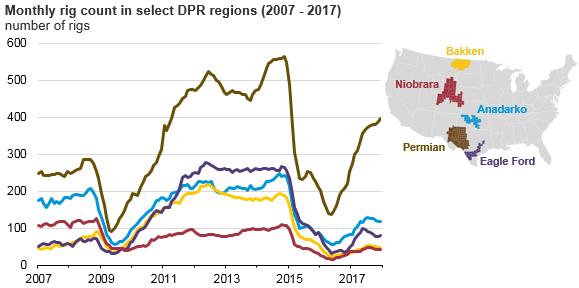
monthly rig count in select DPR regions, as explained in the article text
Source: U.S. Energy Information Administration, Drilling Productivity Report

As rig counts continue to recover from decreases that occurred during 2015 and 2016, producers have increasingly targeted the Permian region, which spans parts of western Texas and eastern New Mexico. The geological structure in the Permian region is more complicated than in other regions, and it took producers more time to advance the drilling and completion technology in the region. However, the Permian region is larger and has more potential for oil production than other regions. Total production and production per new well have increased in the Permian for 11 consecutive years.

Principal contributor: Richard Yan, Jozef Lieskovsky

Statistics
Analysis
Tools
Education
News

Petroleum & Other Liquids

Crude oil, gasoline, heating oil, diesel, propane, and other liquids including biofuels and natural gas liquids.

Natural Gas

Exploration and reserves, storage, imports and exports, production, prices, sales.

Electricity

Sales, revenue and prices, power plants, fuel use, stocks, generation, trade, demand & emissions.

Coal

Reserves, production, prices, employment and productivity, distribution, stocks, imports and exports.

Nuclear & Uranium

Uranium fuel, nuclear reactors, generation, spent fuel.

Renewable & Alternative Fuels

Includes hydropower, solar, wind, geothermal, biomass and ethanol.

EIA Survey Forms

Forms EIA uses to collect energy data including descriptions, links to survey instructions, and additional information.

Total Energy

Comprehensive data summaries, comparisons, analysis, and projections integrated across all energy sources.

U.S. States

State energy information, including overviews, rankings, data, and analyses.

International

International energy information, including overviews, rankings, data, and analyses.

Environment

Greenhouse gas data, voluntary reporting, electric power plant emissions.

Data Tools, Apps, & Maps

Tools to customize searches, view specific data sets, study detailed documentation, and access time-series data.

Open Data

EIA's free and open data available as API, Excel add-in, bulk files, and widgets

EIA Beta

Come test out some of the products still in development and let us know what you think!

Open Source Code

EIA's open source code, available on GitHub.

RSS Feeds

Subscribe to feeds for updates on EIA products including Today in Energy and What's New.