
High natural gas-fired generation leads to rare summer net national weekly storage draw
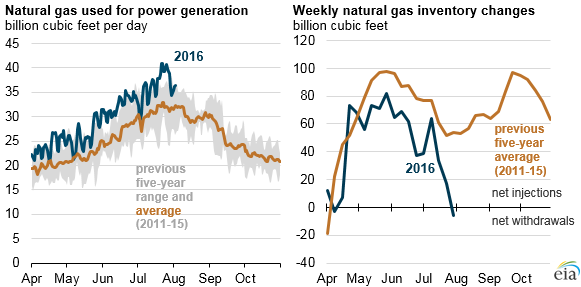
Working natural gas storage inventories posted a rare summer net withdrawal of 6 billion cubic feet (Bcf) for the week ending July 29, 2016, according to EIA's Weekly Natural Gas Storage Report. Record-high consumption of natural gas for electric power generation drove this withdrawal. Although withdrawals in the summer are not unprecedented, and happen regularly in the South Central storage region, the last time a net withdrawal in July occurred on a national basis was in summer 2006. This net withdrawal brings total inventories to 3,288 Bcf, or about 16% higher than the previous five-year average (2011–15).
During the current injection season, net injections had already been much lower than the previous five-year average for almost every week. This trend reflects an unusually high inventory level at the start of the injection season, high power burn, and slightly lower natural gas production, which has recently fallen below year-ago levels. Following a warm 2015–16 winter, inventories headed into the injection season were at record high levels. Despite lower injections, and a net withdrawal this week, inventories are still substantially higher than the five-year average and year-ago levels.
For the week ending July 29, two of the five storage regions (South Central and Pacific) posted overall withdrawals, which more than offset slight injections in the other three regions. In natural gas markets, analysts generally refer to the injection season as running from April 1 through October 31 of each year, but those dates are not strict cutoff points.
The South Central region, in particular, has several salt-dome facilities where natural gas can be drawn down and refilled up to a dozen times a year. These salt-dome facilities allow more flexibility than traditional storage facilities using depleted natural gas fields. Withdrawals in the South Central region, an area that has increasingly relied on natural gas-fired generation, are common in the summer but are usually offset by injections in the other regions.
Principal contributor: Katie Teller
Tags: generation, natural gas, storage