
U.S. production of hydrocarbon gas liquids expected to increase through 2017
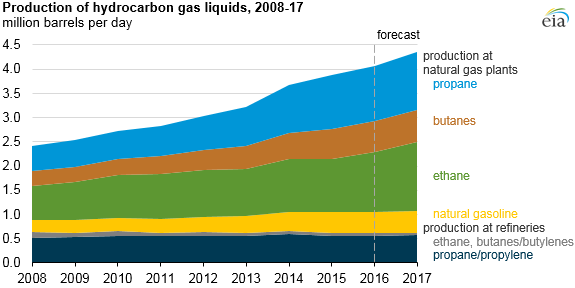
Note: Butanes include both normal butane and isobutane.
U.S. production of hydrocarbon gas liquids (HGL)—a group of products including ethane, propane, butanes, and natural gasoline—is expected to increase from 3.86 million barrels per day in 2015 to 4.33 million b/d in 2017, according to EIA's Short-Term Energy Outlook (STEO). HGLs are produced at both natural gas processing plants and petroleum refineries, but natural gas plants are expected to provide more than 95% of the forecast production growth.
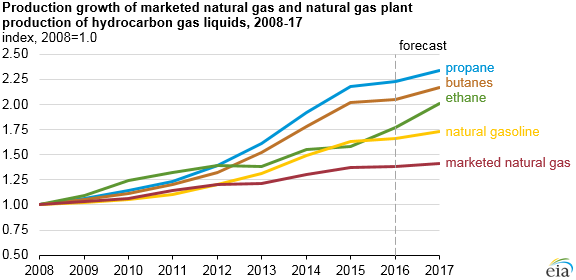
Between 2008 and 2015, HGL production at natural gas processing plants (including fractionation facilities) increased as a by-product of the growing supply of natural gas from shale gas and tight oil formations. Projects that increased the capacity to produce, store, transport, export, and consume HGLs enabled the supply of HGLs to expand at a faster rate than natural gas production. STEO expects HGL production growth to continue to outpace natural gas production growth in 2016 and 2017, as more HGL infrastructure projects are completed.
Ethane production, which was constrained by lack of demand and low prices in recent years, is expected to increase at a faster rate than other HGLs in 2016 and 2017, as expanded petrochemical and export capacity provides new outlets for supply and allows more ethane to be recovered from raw natural gas. Forecast natural gas plant ethane production increases by 300,000 b/d between 2015 and 2017, accounting for two-thirds of total HGL production growth.
The United States, which was a net importer of all HGL products in 2007, became a net exporter of natural gasoline in 2008, of butane and propane in 2011, and of ethane in 2014. Annual average net propane exports (gross exports minus gross imports) increased from 10,000 b/d in 2011 to an estimated 500,000 b/d in 2015, as the capacity to export liquefied petroleum gas (LPG), including propane and butanes, increased by almost 1 million b/d.
STEO projects net propane exports to increase to 640,000 b/d in 2016 and to 740,000 b/d in 2017 as exports ramp up at two Gulf Coast terminal projects that began operating in the second half of 2015, and at another project scheduled to come online in the second half of 2016. In March 2016, the first waterborne shipment of ethane left the United States from new ethane export facilities at Marcus Hook, Pennsylvania. A second ethane export facility is expected to open in the third quarter of 2016 at Morgan's Point, Texas. STEO projects net ethane exports to increase by 80,000 b/d in 2016 and by 90,000 b/d in 2017 as exports ramp up at these terminals.
More information about the HGL outlook for production, consumption, infrastructure, and trade is available in the Short-Term Outlook for Hydrocarbon Gas Liquids, a supplement to EIA's monthly STEO.
Principal contributor: Stacy MacIntyre