
Coal mine starts continue to decline
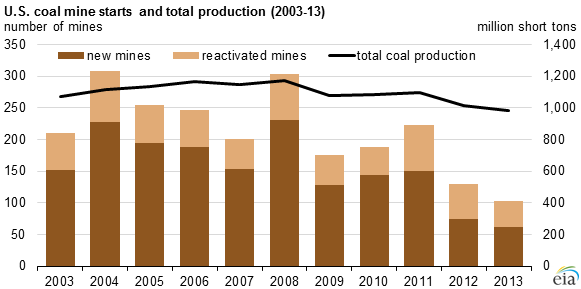
Note: Reactivated mines are those mines with production reported in previous years but not in the preceding year.
The number of new and reactivated coal mines that began production in 2013 fell to the lowest level in at least the past 10 years. The addition of 103 mines in 2013 came as 271 mines were idled or closed, resulting in a 14% decline in the total number of producing coal mines from 2012 to 2013. The 2013 total was 397 fewer coal mines than in 2008, when coal production was at its highest. Although preliminary 2014 data on coal production from the Mine Safety and Health Administration indicate a slight increase both in production and in new and reactivated mines for 2014, these levels will still be below previous levels.
The declining number of new mines reflects reduced investment in the coal industry, strong competition from natural gas, stagnant electricity demand, a weak coal export market, and regulatory and permitting challenges. The lower number of new mines and the closing of less-efficient mines resulted in 2013 having the lowest number of active coal mines on record.
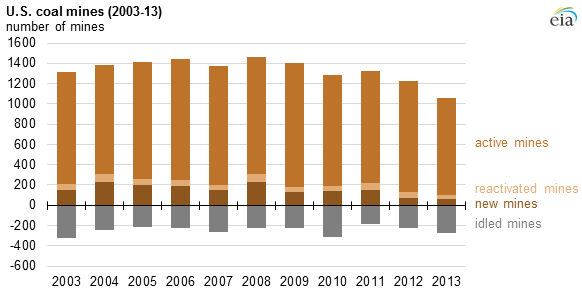
Note: Idled mines include both temporary and permanent closures.
The opening, reopening, and idling or closing of mines serves as a measure of coal industry growth or contraction. The number of mines fluctuates with the demand for coal, almost all of which is used to produce electricity. Examples of this fluctuation can be seen in 2008, when higher coal demand increased the number of new mines, and in 2010, when lower coal demand led to fewer new mines and more idled mines.
Appalachian mines have lower average production than mines in the Western and Interior regions. For instance, in 2013, 877 Appalachian mines produced 270 million short tons of coal compared with 52 Western region mines that produced 530 million short tons. With relatively low average output per mine, the Appalachian region often makes up the largest share of new and reactivated mines, and in years with fewer mine additions, the Appalachian region also makes up most of the decline in new or reactivated mines.
New and reactivated mines help to provide replacement capacity for mines that are idled. Between 2009 and 2013, new and reactivated mines accounted for 63 million short tons of production in their first year, falling short of the 114 million tons of lost production from the last year of production by mines idled between 2008 and 2012.
Principal contributors: JenAlyse Arena, Diane Kearney
Tags: coal, mining, production/supply