
China will soon surpass South Korea, Russia, and Japan in nuclear generating capacity
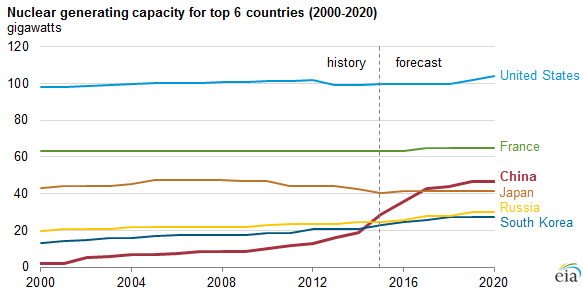
Nuclear power currently makes up slightly more than 2% of China's total power generation. However, the Chinese government has a stated goal to provide at least 15% of overall energy consumption by 2020 (increasing to 20% by 2030) from non-fossil fuel sources, including nuclear, hydroelectricity and other renewable sources. To help achieve this target, China plans to increase nuclear capacity to 58 gigawatts (GW) and to have 30 GW of capacity under construction by 2020.
China has rapidly expanded its nuclear capacity in the past several years, which likely will increase nuclear generation in the next few years. China's net installed nuclear capacity is 23 GW, after the country added 10 reactors totaling more than 10 GW since the beginning of 2013. By the end of 2015, China is expected to surpass South Korea and Russia in nuclear generating capacity, placing it behind only the United States, France, and Japan. China is also constructing an additional 23 GW of nuclear capacity that is slated to become operational by 2020. Operation of these units will make China the leading nuclear generator in Asia. Several more facilities are in various stages of planning.
All of China's nuclear plants are located along the east coast and southern parts of the country, near most of the country's power demand. Following Japan's coastal Fukushima nuclear disaster in 2011, China has increasingly considered construction of inland reactors.
China plans to take an ownership role throughout the entire nuclear supply chain. China intends to build strategic and commercial uranium stockpiles through overseas purchases and continue to develop domestic production in Inner Mongolia (north Central China) and Xinjiang (northwest China). China is developing nuclear fuel reprocessing facilities, which are expected to come online by 2017, according to the World Nuclear Association. China currently imports all of its reactor technology, but the country is in the process of designing its own large pressurized water reactors, the CAP1400, through a technology transfer with U.S.-based Westinghouse. Also, as part of its nuclear expansion program, China signed agreements with several countries (Romania, Argentina, Turkey, and South Africa) in 2014 to finance the construction of nuclear reactors and export its own nuclear technology.
Principal contributor: Candace Dunn
Tags: China, generation, international, nuclear