U.S. Energy Information Administration logo
Skip to sub-navigation
May 30, 2014

Privately owned generators play a growing role in Mexico’s electricity supply
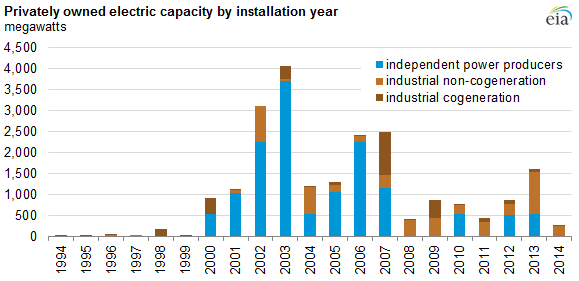
graph of privately owned electric capacity by installation year, as explained in the article text
Source: U.S. Energy Information Administration, based on the Comisión Reguladora de Energia
Note: Distributed or self-supplied generation as well as cogeneration facilities in Mexico are largely concentrated at industrial facilities. Other electric capacity that is not owned by the state-owned corporation includes small generators and capacity designed to import or export electricity across the Mexican border.

Republished May 30, 2014, 10:01 am, text was modified.

In Mexico, most of the electric capacity is owned and operated by the government's Comisión Federal de Electricidad (CFE). Two decades ago, that percentage was close to 100%, but a set of constitutional amendments in 1992 worked to liberalize the Mexican electricity market over time. This legislation opened the operation of electric capacity to the private sector and led to the growth of privately owned capacity additions from independent power producers and industrial facilities.

Private participation in electricity generation is now open through a permitting process for independent power producers and self-supplied and cogeneration facilities (which produce both electricity and steam for industrial processes) that are often located at industrial plants. Capacity is also privately held for imports or exports across Mexican borders as well as for small producers (under 30 megawatts).

Independent power producers currently sell electricity directly to CFE, which owns the distribution network and sells electricity to final end users. However, new legislation passed at the end of 2013 that focused on reforming the petroleum industry also included language to open the distribution side of the electricity market to competition by establishing an independent grid operator and trading market for electricity.
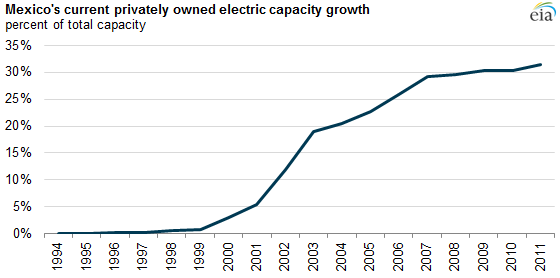
graph of privately owned electric capacity, as explained in the article text
Source: U.S. Energy Information Administration, International Energy Statistics, and the Comisión Reguladora de Energia
Note: The graph above displays the cumulative capacity additions of the currently operating, privately owned electric capacity in Mexico as a percent of total installed capacity.


For more information, see EIA's Country Analysis Brief on Mexico.

Principal contributor: M. Tyson Brown

Statistics
Analysis
Tools
Education
News

Petroleum & Other Liquids

Crude oil, gasoline, heating oil, diesel, propane, and other liquids including biofuels and natural gas liquids.

Natural Gas

Exploration and reserves, storage, imports and exports, production, prices, sales.

Electricity

Sales, revenue and prices, power plants, fuel use, stocks, generation, trade, demand & emissions.

Coal

Reserves, production, prices, employment and productivity, distribution, stocks, imports and exports.

Nuclear & Uranium

Uranium fuel, nuclear reactors, generation, spent fuel.

Renewable & Alternative Fuels

Includes hydropower, solar, wind, geothermal, biomass and ethanol.

EIA Survey Forms

Forms EIA uses to collect energy data including descriptions, links to survey instructions, and additional information.

Total Energy

Comprehensive data summaries, comparisons, analysis, and projections integrated across all energy sources.

U.S. States

State energy information, including overviews, rankings, data, and analyses.

International

International energy information, including overviews, rankings, data, and analyses.

Environment

Greenhouse gas data, voluntary reporting, electric power plant emissions.

Data Tools, Apps, & Maps

Tools to customize searches, view specific data sets, study detailed documentation, and access time-series data.

Open Data

EIA's free and open data available as API, Excel add-in, bulk files, and widgets

EIA Beta

Come test out some of the products still in development and let us know what you think!

Open Source Code

EIA's open source code, available on GitHub.

RSS Feeds

Subscribe to feeds for updates on EIA products including Today in Energy and What's New.