
Increasing renewables likely to reduce coal and natural gas generation over next two years
As of January 1, 2023, we are now publishing four new Today in Energy articles each week, from Monday through Thursday.
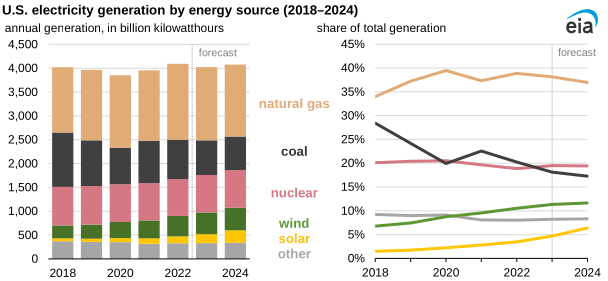
In our latest Short-Term Energy Outlook, we expect that increased U.S. power generation from new renewables capacity—mostly wind and solar—will reduce generation from both coal-fired and natural gas-fired power plants in 2023 and 2024.
With the new solar and wind projects coming online this year, we forecast these two energy sources will account for 16% of total generation in 2023, up from 14% last year and 8% in 2018. In contrast, our forecast share of generation from coal falls from 20% in 2022 to 18% in 2023; the forecast share from natural gas declines from 39% to 38%.
One of the most significant shifts in the mix of U.S. electricity generation over the past few years has been the rapid expansion of renewable energy resources, especially solar and wind. The U.S. electric power sector operated about 74 gigawatts (GW) of solar photovoltaic capacity at the end of 2022, which is about three times the capacity at the end of 2017. U.S. wind power has grown by more than 60% since 2017 to about 143 GW of capacity.
Based on planned additions reported to EIA, solar capacity will expand another 63 GW (84%) by the end of 2024, which is consistent with its declining construction costs and favorable tax credits. As a result of this expected increase in solar capacity, we forecast that the solar generation share will rise from 3% of U.S. generation last year to 5% in 2023 and 6% in 2024. Scheduled growth in wind power is slightly slower this year than in recent years, at about 12 GW of new planned capacity over the next two years. The forecast wind generation share in 2023 remains relatively similar to last year, averaging 11%, and then increases to 12% in 2024.
Much of the growth in solar capacity is in Texas and California, where natural gas has been the primary source of electricity. A growing share of generation from renewables, combined with our forecast of less overall electricity demand this year, displaces some natural gas generation, which will decline slightly, falling from 39% in 2022 to 38% this year and to 37% in 2024. We also expect that the coal generation share will decline by two percentage points to 18% this year, as lower natural gas fuel costs make coal a less competitive source for electricity supply. Our forecast of coal generation falls again in 2024 to 17%.
Principal contributor: Tyler Hodge