U.S. Energy Information Administration logo
Skip to sub-navigation
March 29, 2017

Coal production increases during second half of 2016, but still below 2015 levels
graph of U.S. quarterly coal production, as explained in the article text
Source: U.S. Energy Information Administration, Weekly Coal Report and Quarterly Coal Report and U.S. Mine Safety and Health Administration

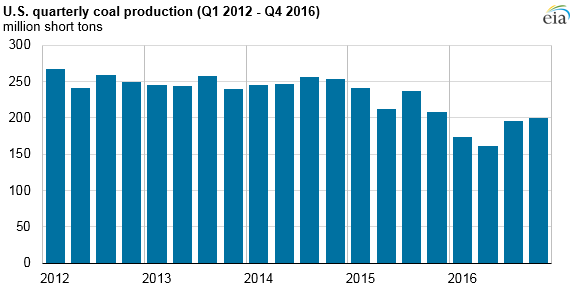
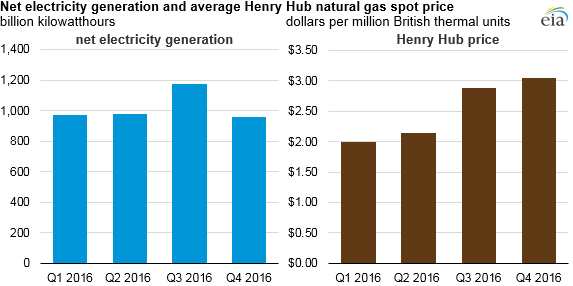
After falling in six out of seven quarters from mid-2014 to mid-2016, coal production rose in the third and fourth quarters of 2016. Among the coal supply regions, the Powder River Basin in Montana and Wyoming saw the largest increases in the second half of 2016. The increases in coal production were driven by an increase in coal-fired electricity generation, which occurred as natural gas prices increased.
graph of net electricity generation and average Henry Hub spot price, as explained in the article text
Source: U.S. Energy Information Administration, Electric Power Monthly, and New York Mercantile Exchange

Electricity generation accounts for more than 90% of domestic coal use. During the third quarter of 2016, warmer-than-normal temperatures led to increased electricity generation—the highest on record for those three months combined—which resulted in higher consumption of coal compared to the first half of 2016. In the fourth quarter, even as electricity generation declined, because natural gas prices remained higher than in previous quarters, the natural gas share of electricity generation fell and coal consumption increased slightly. During December, the coal share of monthly electricity generation surpassed that of natural gas for the first time since January 2016.
graph of U.S. quarterly coal production by basin, as explained in the article text
Source: U.S. Energy Information Administration, Quarterly Coal Report, and U.S. Mine Safety and Health Administration

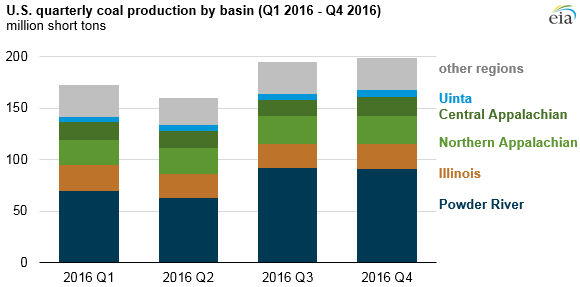
Regionally, production from the Powder River Basin (PRB) increased the most from the first half of 2016 to the second half of 2016. Coal production from other regions, including the Appalachian and Illinois basins, remained relatively flat. Increased demand for Power River Basin coal was not limited to any geographic region. Almost all of the 29 states that received PRB coal previously increased their consumption during the second half of 2016. Among those states, Texas, Illinois, Missouri, and Wisconsin collectively accounted for approximately half of the total increase in PRB coal demand.

Principal contributor: Brian Park

Statistics
Analysis
Tools
Education
News

Petroleum & Other Liquids

Crude oil, gasoline, heating oil, diesel, propane, and other liquids including biofuels and natural gas liquids.

Natural Gas

Exploration and reserves, storage, imports and exports, production, prices, sales.

Electricity

Sales, revenue and prices, power plants, fuel use, stocks, generation, trade, demand & emissions.

Coal

Reserves, production, prices, employment and productivity, distribution, stocks, imports and exports.

Nuclear & Uranium

Uranium fuel, nuclear reactors, generation, spent fuel.

Renewable & Alternative Fuels

Includes hydropower, solar, wind, geothermal, biomass and ethanol.

EIA Survey Forms

Forms EIA uses to collect energy data including descriptions, links to survey instructions, and additional information.

Total Energy

Comprehensive data summaries, comparisons, analysis, and projections integrated across all energy sources.

U.S. States

State energy information, including overviews, rankings, data, and analyses.

International

International energy information, including overviews, rankings, data, and analyses.

Environment

Greenhouse gas data, voluntary reporting, electric power plant emissions.

Data Tools, Apps, & Maps

Tools to customize searches, view specific data sets, study detailed documentation, and access time-series data.

Open Data

EIA's free and open data available as API, Excel add-in, bulk files, and widgets

EIA Beta

Come test out some of the products still in development and let us know what you think!

Open Source Code

EIA's open source code, available on GitHub.

RSS Feeds

Subscribe to feeds for updates on EIA products including Today in Energy and What's New.