
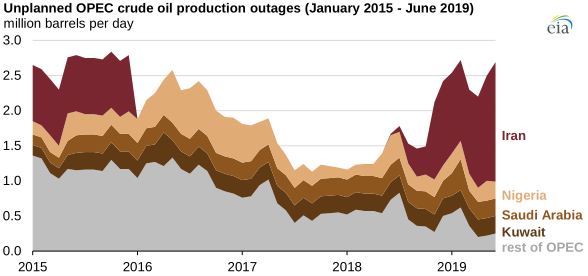
Iran drives unplanned OPEC crude oil production outage to highest levels since late 2015
Note: OPEC disruptions include crude oil only.
Unplanned crude oil production outages for the Organization of the Petroleum Exporting Countries (OPEC) averaged 2.5 million barrels per day (b/d) in the first half of 2019, the highest six-month average since the end of 2015. EIA estimates that in June, Iran alone accounted for more than 60% (1.7 million b/d) of all OPEC unplanned outages.
EIA differentiates among declines in production resulting from unplanned production outages, permanent losses of production capacity, and voluntary production cutbacks for OPEC members. Only the first of those categories is included in the historical unplanned production outage estimates that EIA publishes in its monthly Short-Term Energy Outlook (STEO).
Unplanned production outages include, but are not limited to, sanctions, armed conflicts, political disputes, labor actions, natural disasters, and unplanned maintenance. Unplanned outages can be short-lived or last for a number of years, but as long as the production capacity is not lost, EIA tracks these disruptions as outages rather than lost capacity.
Loss of production capacity includes natural capacity declines and declines resulting from irreparable damage that are unlikely to return within one year. This lost capacity cannot contribute to global supply without significant investment and lead time.
Voluntary cutbacks are associated with OPEC production agreements and only apply to OPEC members. Voluntary cutbacks count toward the country’s spare capacity but are not counted as unplanned production outages.
EIA defines spare crude oil production capacity—which only applies to OPEC members adhering to OPEC production agreements—as potential oil production that could be brought online within 30 days and sustained for at least 90 days, consistent with sound business practices. EIA does not include unplanned crude oil production outages in its assessment of spare production capacity.
As an example, EIA considers Iranian production declines that result from U.S. sanctions to be unplanned production outages, making Iran a significant contributor to the total OPEC unplanned crude oil production outages. During the fourth quarter of 2015, before the Joint Comprehensive Plan of Action became effective in January 2016, EIA estimated that an average 800,000 b/d of Iranian production was disrupted. In the first quarter of 2019, the first full quarter since U.S. sanctions on Iran were re-imposed in November 2018, Iranian disruptions averaged 1.2 million b/d.
Another long-term contributor to EIA’s estimate of OPEC unplanned crude oil production outages is the Partitioned Neutral Zone (PNZ) between Kuwait and Saudi Arabia. Production halted there in 2014 because of a political dispute between the two countries. EIA attributes half of the PNZ’s estimated 500,000 b/d production capacity to each country.
In the July 2019 STEO, EIA only considered about 100,000 b/d of Venezuela’s 130,000 b/d production decline from January to February as an unplanned crude oil production outage. After a series of ongoing nationwide power outages in Venezuela that began on March 7 and cut electricity to the country's oil-producing areas, EIA estimates that PdVSA, Venezuela’s national oil company, could not restart the disrupted production because of deteriorating infrastructure, and the previously disrupted 100,000 b/d became lost capacity.
Principal contributor: Emily Sandys
Tags: production/supply, outages, OPEC, liquid fuels, crude oil, oil/petroleum, Iran