U.S. Energy Information Administration logo
Skip to sub-navigation
April 3, 2018

In 2017, U.S. electricity sales fell by the greatest amount since the recession
U.S. retail electricity sales, as explained in the article text
Source: U.S. Energy Information Administration, Electric Power Monthly

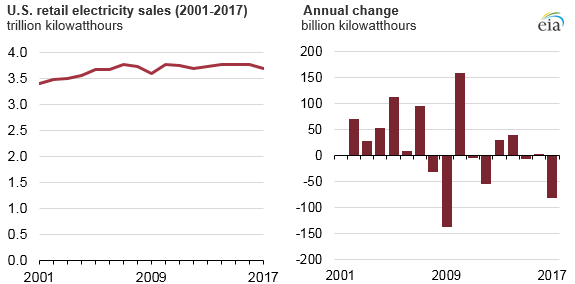
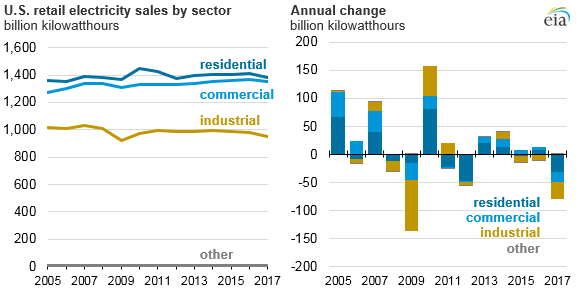
U.S. retail electricity sales fell by 80 billion kilowatthours (kWh) in 2017, the largest drop since the economic recession in 2009. The 2% decrease in 2017 reflects lower retail sales in the residential, commercial, and industrial sectors and is largely attributable to milder weather. Total electricity retail sales in 2017 were 3,682 billion kWh, nearly identical to the levels seen more than a decade before, in 2006.
U.S. retail electricity sales by sector, as explained in the article text
Source: U.S. Energy Information Administration, Electric Power Monthly

The residential sector buys the most electricity from the grid, accounting for slightly more than 37% of the 2017 total. Commercial sector electricity retail sales made up slightly less than 37% of the total in 2017, and the industrial sector made up about 26%.

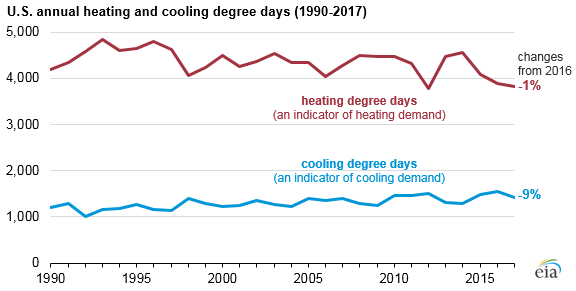
Although factors such as electricity prices, energy efficiency, and macroeconomic cycles play a role in the use of electricity in each sector, most of the year-over-year changes in sales in 2017 were attributable to changes in weather. With few exceptions, air conditioning and other cooling equipment is powered by electricity, so warmer weather in summer months often results in greater use of air conditioning and higher retail electricity sales. Cooling degree days, an indicator of cooling-related energy demand, were 9% lower in 2017 compared with 2016 levels, indicating a cooler summer in 2017 and less demand for air conditioning.
U.S. annual heating and cooling degree days, as explained in the article text
Source: U.S. Energy Information Administration, Short-Term Energy Outlook

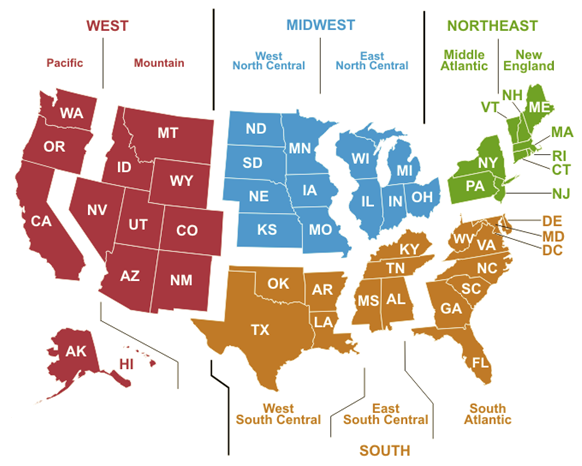
Although fuels other than electricity such as natural gas, heating oil, and propane can be used to generate heat, electricity use also increases in colder weather. Heating degree days, an indicator of heating-related energy demand, were 1% lower in 2017 compared with 2016 levels. In the South census region, where homes and businesses are more likely to heat with electricity, 2017 heating degree days were 8% to 10% lower than in 2016.
More data about retail sales of electricity are available in EIA’s Electric Power Monthly.

Principal contributor: Owen Comstock

Statistics
Analysis
Tools
Education
News

Petroleum & Other Liquids

Crude oil, gasoline, heating oil, diesel, propane, and other liquids including biofuels and natural gas liquids.

Natural Gas

Exploration and reserves, storage, imports and exports, production, prices, sales.

Electricity

Sales, revenue and prices, power plants, fuel use, stocks, generation, trade, demand & emissions.

Coal

Reserves, production, prices, employment and productivity, distribution, stocks, imports and exports.

Nuclear & Uranium

Uranium fuel, nuclear reactors, generation, spent fuel.

Renewable & Alternative Fuels

Includes hydropower, solar, wind, geothermal, biomass and ethanol.

EIA Survey Forms

Forms EIA uses to collect energy data including descriptions, links to survey instructions, and additional information.

Total Energy

Comprehensive data summaries, comparisons, analysis, and projections integrated across all energy sources.

U.S. States

State energy information, including overviews, rankings, data, and analyses.

International

International energy information, including overviews, rankings, data, and analyses.

Environment

Greenhouse gas data, voluntary reporting, electric power plant emissions.

Data Tools, Apps, & Maps

Tools to customize searches, view specific data sets, study detailed documentation, and access time-series data.

Open Data

EIA's free and open data available as API, Excel add-in, bulk files, and widgets

EIA Beta

Come test out some of the products still in development and let us know what you think!

Open Source Code

EIA's open source code, available on GitHub.

RSS Feeds

Subscribe to feeds for updates on EIA products including Today in Energy and What's New.