
Electric grid planners: demand response and energy efficiency to increase
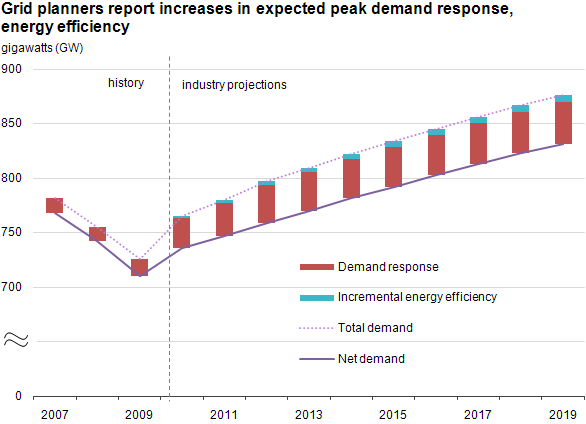
Note: All data are reported for time of summer peak, rather than overall demand. Includes all controllable and dispatchable demand response, and assumes these decrease demand. Incremental energy efficiency is the estimated incremental conservation impact of passive energy efficiency programs, representing the decrease below the embedded amount from the base year.
Electric power system planners expect increased participation in demand response and energy efficiency programs to decrease peak electric power demand by up to 5% over the next ten years. In the graph above, the solid purple line presents the expected peak electric demand based on system planners' reported projections to EIA. Demand response and new energy conservation programs (the red and blue bars, respectively) work to decrease peak demand from what it would otherwise be (dotted line) absent those programs.
Demand response programs enable electric power customers to reduce their demand for power during peak load periods. Only those programs that allow system operators to directly reduce load are included in the chart. Other programs where customers retain control, like those involving time-of-use rates, also exist. Energy efficiency, as used in this analysis, refers to the impact on peak demand from conservation activities such as the installation of more efficient lighting and appliances.
EIA's Annual Energy Outlook (AEO 2011 Early Release) also projects demand response actions in the electric power sector. The AEO's end-use electricity consumption modeling is an annual model and therefore does not provide peak demand projections. However, energy efficiency improvements are included due to technology adoption, equipment standards, and building codes. For additional information about select stock efficiencies and building shell improvements in the residential and commercial sectors, see AEO 2011 supplementary tables 31 and 32.
The North American Electric Reliability Corporation (NERC) collects data on expected demand and capacity from grid operators, electric utilities, and other users, owners, and operators of the bulk power system. These data feed NERC's reliability assessments, are collected via survey Form EIA-411 to support EIA's statistics and analyses, and are also posted for the public on EIA's website in the Electric Reliability section. Overall, demand growth expectations reported to EIA in 2010 declined from two years earlier. In its 2010 Long-Term Reliability Assessment, NERC reported that increasing participation in demand response programs is contributing to the overall slowing of demand growth.