
Demand response can lower electric power load when needed
Consumers can play a major role in ensuring reliable electricity supply by reducing their electricity use on days when power demand is high relative to available supply.
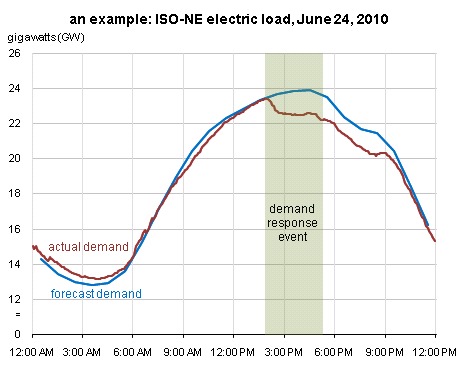
For example, the afternoon of June 24, 2010 was hot and humid in New England. Approximately 1,800 megawatts (MW) of unplanned generator outages left the independent system operator (ISO-NE) with little in the way of operating reserves (backup generation). Concern mounted as higher-than-predicted temperatures pushed actual electric load (the electricity that the system operator must supply, as shown by the red line on the chart below) closer to the forecast (blue line).
Source: ISO New England
Chart data
To restore an adequate level of operating reserves, ISO-NE called on their demand response program. That afternoon, ISO-NE asked utilities across New England to activate their demand response resources to reduce load by 669 MW. Demand response succeeded in reducing demand by 653 MW.
Thunderstorms moving through southwestern Connecticut, cooling the air and reducing air conditioning use, made up for the remainder of the initial 800-MW load reduction (the difference between the red line and the blue line above, at about 3:00 pm). The storms moved on through the region, further reducing load in areas where lightning caused local distribution outages
Demand response programs are growing in participation and variety. Historically, industrial or commercial customers with relatively large electric loads signed contracts allowing utilities to interrupt their use when necessary. Increasingly, independent "curtailment service providers" aggregate demand response from smaller commercial and residential customers, for instance using controllable thermostats to cycle air conditioning units. In the New England example above, customers opt into a price-based program, receiving a refund at wholesale power prices in exchange for reducing their load during a demand response "event" (a short period of time, determined by the utility or ISO).