
U.S. capacity to convert waste to energy declines after remaining steady since 1994
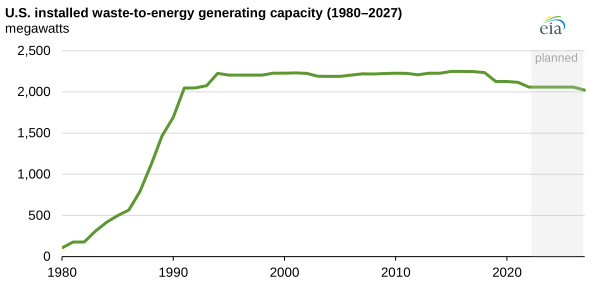
U.S. waste-to-energy (WTE) electric-generating capacity has recently started to decline after averaging around 2,219 megawatts (MW) for 24 years, according to our June 2022 Preliminary Monthly Electric Generator Inventory. From 2018 to 2022, 188 MW of WTE capacity retired, and another 36 MW is expected to retire by 2027. Low electricity prices, local opposition, and continued policy concerns about emissions have pressured WTE plant owners to close in recent years.
WTE power plants convert the combustible content of municipal solid waste (MSW) into energy. At mass burn facilities, trash waste is unloaded from collection trucks, freight trucks, and railcars into a storage bunker. An overhead crane then sorts the waste and lifts it into the combustion chamber to be burned. The heat released converts water to steam, which is routed to a turbine generator to produce electricity. WTE plants are primarily intended as a waste management option; electricity generation is considered a secondary benefit.
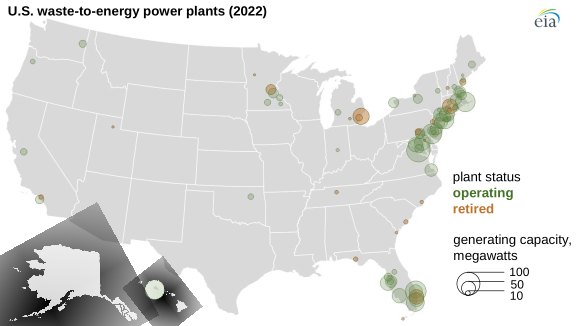
WTE plants account for a relatively small portion of U.S. electric generating capacity and are mainly concentrated in the Northeast and in Florida. Florida has 540 MW of WTE generating capacity, the most of any U.S. state, and New York and Pennsylvania have the second- and third-most WTE capacity—261 MW in New York and 248 MW in Pennsylvania.
About 90% of WTE electricity generation capacity was added between 1980 and 1995, when landfilling MSW was relatively expensive. However, in the mid-1990s, as emission concerns grew, most existing facilities had to install air pollution control systems or be shut down, and developers stopped building new MSW-fired electric generation. In 2015, Florida’s Palm Beach Renewable Energy Facility 2 became the first new WTE plant to come online in the United States since 1995.
In addition to emissions concerns, the upfront capital costs of building a new MSW combustion plant can be significant, and the plant could provide only limited economic benefits when electricity prices are low. A new plant generally requires at least $100 million to finance construction; larger plants can require double to triple that amount.
Principal contributors: Slade Johnson, Katherine Antonio, Alex Mey
Tags: generation, electricity, waste-to-energy, states, capacity, map