
Natural gas-fired electricity generation this summer expected to be near record high
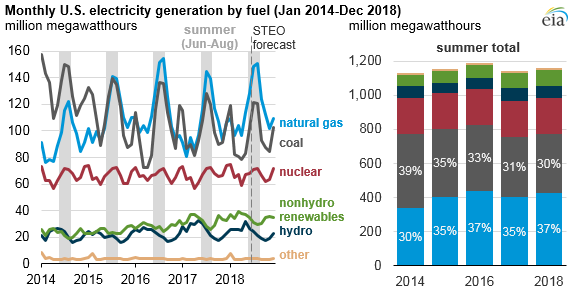
EIA’s July 2018 Short-Term Energy Outlook (STEO) expects natural gas-fired power plants to supply 37% of U.S. electricity generation this summer (June, July, and August), near the record-high natural gas-fired generation share in summer 2016. EIA forecasts the share of generation from coal-fired power plants will drop slightly to 30% in summer 2018, continuing a multi-year trend of lower coal-fired electricity generation.
The share of electricity generation supplied by natural gas-fired power plants has increased over the past decade, while the share supplied by coal has fallen, primarily as a result of sustained low natural gas prices, increases in natural gas-fired capacity, and retirements of coal-fired generating capacity. Over the three-year period from 2015 to 2017, the cost of natural gas delivered to electric generators averaged $3.16 per million Btu (MMBtu), compared with $7.69/MMBtu between 2006 and 2008.
The combination of relatively low natural gas prices, environmental regulations, and supportive renewable energy policies has led the industry to build new natural gas-fired and renewable capacity and to retire coal-fired power plants. As reported on EIA’s Preliminary Monthly Electric Generator Inventory, power plant operators added 5.4 gigawatts (GW) of new natural gas-fired generating capacity during the first four months of 2018 with an additional 15 GW scheduled to come online through the end of the year. This addition would be the largest increase in natural gas capacity since 2004. The electric industry also added 2.6 GW of new utility-scale solar and wind generating capacity during the first four months of the year, with an additional 9.6 GW scheduled to come online by the end of 2018. More than 10 GW of coal-fired capacity was retired over the 12-month period ending April 2018.
EIA forecasts the delivered cost of natural gas will average $3.16/MMBtu this summer, 2% lower than the average cost during the summer of 2017. In contrast, the cost of coal delivered to electric generators is forecast to rise slightly this summer. The continued low cost of natural gas, along with the recent additions of natural gas-fired capacity and retirements of coal power plants, drive EIA’s expectation that natural gas will contribute a growing share of electricity generation this summer, while coal's share will fall.
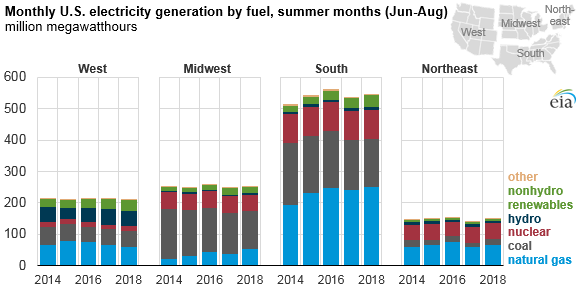
The largest changes in generation shares occur in the Midwest census region. During the summer of 2018, EIA expects natural gas will supply 20% of electricity in the Midwest, up from 15% last summer. The forecast share of generation from coal in the Midwest falls from 53% last summer to 49% this summer.
Unlike the rest of the country, natural gas generation in the West census region is forecast to decline this summer as renewable energy generating capacity increases. Nearly 2 GW of utility-scale solar generating capacity came online in the West census region during the 12 months ending in April. EIA forecasts the share of generation in the West from renewable sources other than hydropower will increase to 16% in summer 2018, up from 14% last summer.
Principal contributor: Tyler Hodge