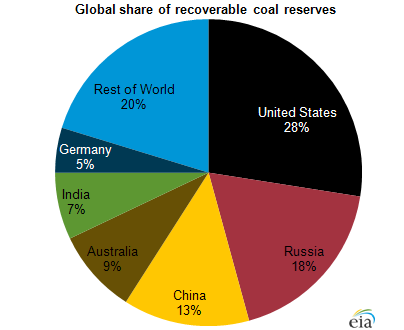
The United States leads the world with over 260 billion short tons of recoverable coal reserves—28% of total global reserves and 50% more than Russia, which possesses the world's second largest reserves. Despite significant U.S. coal production since the industrial revolution, recoverable domestic coal reserves at current mining levels would last 222 years.
Coal reserves are reported by coal types: bituminous and anthracite (46%), subbituminous (41%), and lignite (12%). Appalachia is the largest producer of bituminous and anthracite coal, while large quantities of subbituminous coal are produced in the Powder River Basin (covering much of Wyoming, as well as parts of Montana). Texas leads lignite production.
Tags: coal, international, reserves, Russia, United States
Crude oil, gasoline, heating oil, diesel, propane, and other liquids including biofuels and natural gas liquids.
Exploration and reserves, storage, imports and exports, production, prices, sales.
Sales, revenue and prices, power plants, fuel use, stocks, generation, trade, demand & emissions.
Reserves, production, prices, employment and productivity, distribution, stocks, imports and exports.
Uranium fuel, nuclear reactors, generation, spent fuel.
Includes hydropower, solar, wind, geothermal, biomass and ethanol.
Forms EIA uses to collect energy data including descriptions, links to survey instructions, and additional information.
Comprehensive data summaries, comparisons, analysis, and projections integrated across all energy sources.
Energy use in homes, commercial buildings, manufacturing, and transportation.
State energy information, including overviews, rankings, data, and analyses.
International energy information, including overviews, rankings, data, and analyses.
Greenhouse gas data, voluntary reporting, electric power plant emissions.
Monthly and yearly energy forecasts, analysis of energy topics, financial analysis, congressional reports.
Special market analysis and/or data requests.
International energy analyses.
Tools to customize searches, view specific data sets, study detailed documentation, and access time-series data.
EIA's free and open data available as API, Excel add-in, bulk files, and widgets
Come test out some of the products still in development and let us know what you think!
EIA's open source code, available on GitHub.
Sign up for email subscriptions to receive messages about specific EIA products
Subscribe to feeds for updates on EIA products including Today in Energy and What's New.
Lesson plans, science fair experiments, field trips, teacher guide, and career corner.