
Industrial onsite electricity concentrated in chemicals, oil, and paper manufacturing
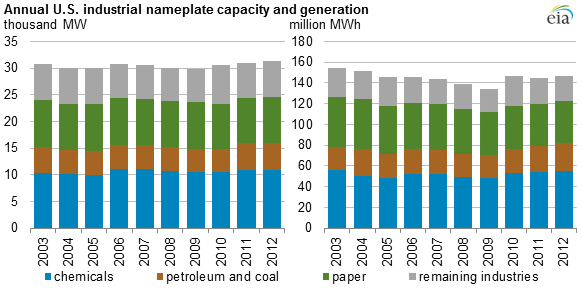
Onsite industrial generation represents approximately 3% of current U.S. generating capacity and approximately 4% of total megawatthours (MWh) of electricity generated in 2012, the latest year for which final data are available. More than 90% of the industrial generation capacity is concentrated in five industries. Of these industries, the chemicals, paper, and petroleum and coal industries account for more than 80% of onsite industrial generation, with the primary metals and food industries representing the remaining 20%.
Combined heat and power (CHP) facilities tend to be built in conjunction with certain industries that have heat or steam demands that directly affect their economic potential and profitability. Continuous operations with fairly constant heat or steam demands, coupled with meeting partial electricity demands, bolster the technical potential and likelihood of adoption of an industrial CHP, or cogeneration, facility and also may result in greater use of these facilities.
Power plants configured to produce both electricity and steam for other uses have a long history in the industrial sector. In the early 1900s, onsite generation was commonplace and also accounted for the majority of U.S. units because of the need for industrial heat, combined with the poor reliability and high cost of contemporary network-delivered electrical service. Subsequent improvements in electric grids throughout the nation led to a substantial decline in industrial cogeneration, with most electricity used at industrial facilities now coming from the grid rather than from onsite sources.
While the technical potential of CHP—the amount of industrial CHP possible to meet both heat and partial electric demands without taking into account measures of its cost-effectiveness—spans the entire industrial sector, the economic potential—the amount of industrial CHP that could be adopted because of its economic feasibility—helps to concentrate such potential in a few industries.
There is significant technical potential for more industrial cogeneration, which offers the potential for energy savings and cost reductions compared to the separate production of electricity and heat. Multiple policies at the federal, state, and local levels aim to promote CHP. However, even though expenditures for purchasing electricity are a significant cost for energy-intensive manufacturing facilities, the number of manufacturing facilities with and without active cogeneration suggest that CHP still faces significant challenges.
In addition to the direct sensitivities to the future cost of electricity and input fuels prices, there are other notable concerns particular to CHP investments identified by industry:
- High or higher back-up changes or stand-by rates offered to industrial plants that want to pursue cogeneration while still maintaining a connection to the electric grid
- Possible changes in CHP-related tax issues
- State environmental policies
- State siting and permitting requirements
- Various federal standards
Principal contributors: Mark Schipper, Joel Douglas
Tags: capacity, efficiency, electricity, generation, industrial