U.S. Energy Information Administration logo
Skip to sub-navigation
May 24, 2012

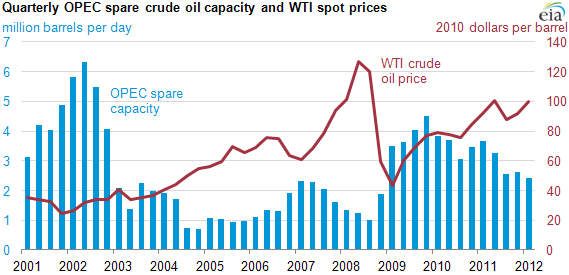
OPEC spare capacity in the first quarter of 2012 at lowest level since 2008
graph of Quarterly OPEC spare crude oil capacity and WTI spot prices, as described in the article text
Source: U.S. Energy Information Administration, Short-Term Energy Outlook, May 2012.
Download CSV Data

The U.S. Energy Information Administration (EIA) estimates that global spare crude oil production capacity averaged about 2.4 million barrels per day (bbl/d) during the first quarter of 2012, down about 1.3 million bbl/d from the same period in 2011 (see chart above). The world's spare crude oil production capacity is held by member countries of the Organization of the Petroleum Exporting Countries (OPEC). Spare capacity can serve as a buffer against oil market disruptions, and it gives OPEC additional political and economic influence in world markets. There is little or no spare capacity outside of the OPEC member countries.

Spare crude oil production capacity is now less than 3% of total world crude oil consumption—the lowest proportion since the fourth quarter of 2008—based on EIA estimates.

Spare crude oil production capacity is an important indicator of producers' ability to respond to potential disruptions; consequently, low spare oil production capacity tends to be associated with high oil prices and high oil price volatility. Similarly, rising spare capacity tends to be associated with falling oil prices and reduced volatility. However, spare capacity must also be considered in the context of a number of other market factors that can drive crude oil prices, such as global supply, demand, and inventory levels.

EIA defines spare crude oil production capacity as potential oil production that could be brought online within 30 days and sustained for at least 90 days, consistent with sound business practices. This does not include oil production increases that could not be sustained without degrading the future production capacity of a field.

Statistics
Analysis
Tools
Education
News

Petroleum & Other Liquids

Crude oil, gasoline, heating oil, diesel, propane, and other liquids including biofuels and natural gas liquids.

Natural Gas

Exploration and reserves, storage, imports and exports, production, prices, sales.

Electricity

Sales, revenue and prices, power plants, fuel use, stocks, generation, trade, demand & emissions.

Coal

Reserves, production, prices, employment and productivity, distribution, stocks, imports and exports.

Nuclear & Uranium

Uranium fuel, nuclear reactors, generation, spent fuel.

Renewable & Alternative Fuels

Includes hydropower, solar, wind, geothermal, biomass and ethanol.

EIA Survey Forms

Forms EIA uses to collect energy data including descriptions, links to survey instructions, and additional information.

Total Energy

Comprehensive data summaries, comparisons, analysis, and projections integrated across all energy sources.

U.S. States

State energy information, including overviews, rankings, data, and analyses.

International

International energy information, including overviews, rankings, data, and analyses.

Environment

Greenhouse gas data, voluntary reporting, electric power plant emissions.

Data Tools, Apps, & Maps

Tools to customize searches, view specific data sets, study detailed documentation, and access time-series data.

Open Data

EIA's free and open data available as API, Excel add-in, bulk files, and widgets

EIA Beta

Come test out some of the products still in development and let us know what you think!

Open Source Code

EIA's open source code, available on GitHub.

RSS Feeds

Subscribe to feeds for updates on EIA products including Today in Energy and What's New.