
U.S. ethane exports set a monthly record in March 2023
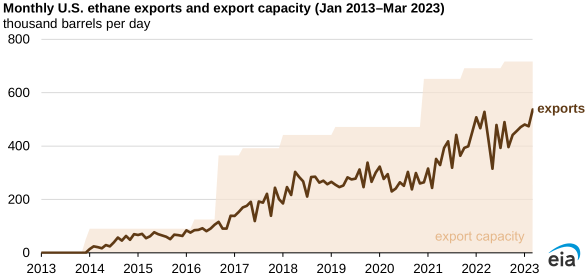
U.S. ethane exports averaged 537,000 barrels per day (b/d) in March 2023, an all-time high since the United States began exporting ethane nearly a decade ago, according to our May 2023 Petroleum Supply Monthly. Increased export capacity in recent years has allowed more ethane to be exported.
Ethane serves mainly as a petrochemical feedstock to produce ethylene, which is used to make plastics and resins. Ethane and steam are fed into an ethylene cracker that heats the mixture to break down (or crack) the ethane molecule, resulting in a product stream composed primarily of ethylene, along with some coproducts.
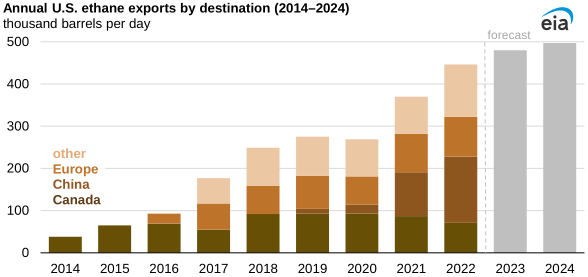
The United States began exporting ethane in 2014 via pipeline to petrochemical plants in Canada. In 2016, the United States started exporting ethane to countries in Europe from marine export terminals. By the end of 2022, the United States was exporting ethane to nine countries.
The largest share for U.S. ethane exports in 2022 went to China. U.S. ethane exports to China increased from 21,000 b/d in 2020 to 157,000 b/d in 2022 as China brought more ethylene crackers online. The United States started exporting small amounts of ethane to China in 2019.
Three marine export terminals in the United States ship cryogenically cooled ethane overseas in tankers such as very large ethane carriers (VLECs). The number and capacity of vessels shipping U.S. ethane is growing as global ethane demand increases.
Various feedstocks can be used to produce ethylene in petrochemical crackers. The decision to use ethane rather than other feedstocks depends on relative prices and whether a petrochemical cracker has the capacity to switch feedstocks.
Until the United States became a major ethane exporter in 2016, only a few countries had the infrastructure to use ethane as a petrochemical feedstock. Across most of Asia and Europe, naphtha serves as the primary petrochemical feedstock, but demand for ethylene is outpacing demand for other coproducts, reducing the appeal of naphtha cracking. Cracking ethane can yield more than 80% ethylene; cracking naphtha can yield as little as 30% ethylene. Ethane’s growth as an ethylene feedstock in the United States and, increasingly, around the world, is attributable to its low relative cost, high ethylene yield, and low number of coproducts.
U.S. ethane exports have increased in almost every year since they began in 2014, excluding only 2020, when the economic slowdown caused by the COVID-19 pandemic triggered a slight decrease. We forecast that ethane exports will average 7% higher in 2023 than in 2022, at 480,000 b/d, according to our June Short-Term Energy Outlook. As global demand and capacity for ethane as a petrochemical feedstock grows, we forecast that ethane exports will average nearly 500,000 b/d by the end of 2024.
Principal contributor: Josh Eiermann
Tags: international, China, exports/imports, Canada, Europe, oil/petroleum, ethane