
Changing energy efficiency and fuel economy standards affects energy consumption
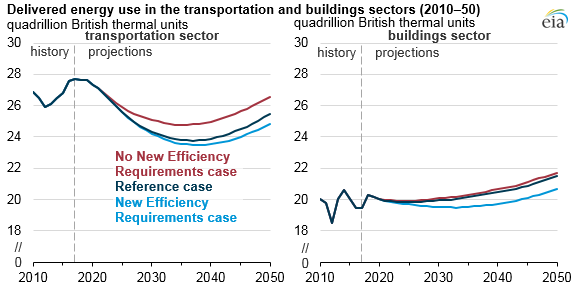
Legislation passed in the 1970s and 1980s and updated in subsequent decades established mandatory federal minimum energy efficiency standards for equipment and appliances in buildings and fuel economy standards for light-duty vehicles (LDVs). Three scenarios in EIA’s Annual Energy Outlook 2018 (AEO2018) examine the impacts of varying energy efficiency policies on end-use consumption, including what could happen under current laws and what might happen if energy efficiency policies were made more or less stringent.
EIA’s AEO2018 Reference case reflects current laws and regulations and generally does not project additional standards or regulations beyond those with established implementation dates. For appliance standards, this assumption reflects finalized regulations with future compliance dates, such as updated minimum efficiency levels for general service light bulbs in 2020.
For new LDVs, these standards include the joint attribute-based Corporate Average Fuel Economy (CAFE) and greenhouse gas emissions (GHG) standards through model year (MY) 2025, as issued in 2012. In the Reference case, CAFE and GHG emissions standards are assumed to remain constant at MY 2025 levels in subsequent model years. In the near-term portion of the Reference case, these existing regulations moderate delivered energy use for buildings and reduce delivered energy use in transportation as efficiency gains offset growth in energy demand.
The New Efficiency Requirements case includes at least one additional round of federal minimum efficiency standards for residential and commercial end uses such as space heating and cooling, water heating, lighting, ventilation, clothes washing and drying, and refrigeration—end uses that cover more than half of the energy consumed in the residential and commercial sectors.
This equipment may be used for many years, so incremental improvements for new equipment mean consumers reduce their energy use over time. Extension of existing standards in the New Efficiency Requirements case leads to delivered energy consumption in buildings in 2050 that is 3.9% lower than in the Reference case. In particular, electricity use per household in 2050 is 3.7% lower than it otherwise would be in the Reference case.
The New Efficiency Requirements case also increases LDV CAFE and GHG emission standards through MY 2050. LDV energy use in 2017 was 15.3 quadrillion British thermal units (Btu), or 8.3 million barrels per day (b/d) oil equivalent, an estimated 55% of the energy consumed in the transportation sector. Extending CAFE and GHG emissions requirements results in delivered energy consumption in the transportation sector that is 2.5% lower, or 0.3 million b/d oil equivalent, in 2050 in the New Efficiency Requirements case compared with the Reference case.
The No New Efficiency Requirements case removes residential and commercial federal efficiency standards slated to go into effect after 2018 for various equipment and appliances. Eliminating future standards not yet in effect for select equipment results in residential and commercial delivered energy consumption in the No New Efficiency Requirements case that is more than 1% higher in 2050 than in the Reference case.
The No New Efficiency Requirements case maintains LDV CAFE and GHG emissions standards at MY 2021 levels. Maintaining LDV CAFE and GHG emissions requirements leads to 4.4% more delivered energy consumption, or 0.6 million b/d oil equivalent, in 2050 than in the Reference case.
The full Issues in Focus article Alternative Policies in Power Generation and Energy Demand Markets provides detailed discussions of the assumptions and results for the two end-use efficiency policy scenarios.
Principal contributors: Kevin Jarzomski, Nicholas Chase