
Stand-alone natural gas wells driving new growth in Saudi Arabia’s natural gas production
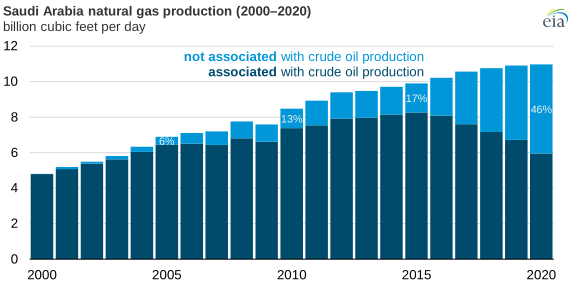
Saudi Arabia’s dry natural gas production reached an average of 11 billion cubic feet per day (Bcf/d) for the first time in 2020, a 30% increase from 2010. Oil production cuts related to the December 2016 OPEC+ agreement have reduced Saudi Arabia’s associated natural gas production (natural gas produced as a by-product of oil production). However, the country’s total natural gas output has steadily grown over the past two decades because of the development of non-associated, or stand-alone, natural gas fields.
Natural gas produced from non-associated gas fields in Saudi Arabia increased from nothing in 2000 to 46% of total production in 2020. In 2016, Saudi Aramco, the national oil company, began to prioritize the development of non-associated gas fields, located mostly offshore.
Saudi Aramco’s strategy includes plans to develop more non-associated natural gas, including unconventional resources, and to further expand natural gas reserves with new reservoirs near existing fields and new discoveries to help meet growing domestic demand. Saudi Arabia’s proved natural gas reserves totaled 333 trillion cubic feet (Tcf) as of January 2021, including those in an area shared with Kuwait known as the Neutral Zone. Saudi Arabia was the sixth-largest natural gas producer in the world behind Russia, Iran, Qatar, the United States, and Turkmenistan in 2020.
At the end of 2021, Saudi Aramco awarded contracts to energy companies to develop the country’s largest unconventional field, Jafurah, located to the east of Ghawar oil field near the Persian Gulf. The company expects the Jafurah project to begin production in 2025. Saudi Aramco expects that by 2030, the project will have a maximum capacity of 2 Bcf/d of dry natural gas, 418 million cubic feet per day (MMcf/d) of ethane, and 630,000 barrels per day of condensate.
Saudi Arabia does not import or export natural gas, but it expects to begin exporting natural gas by 2030. The government of Saudi Arabia also plans to replace its crude oil, fuel oil, and diesel-powered electric generators with natural gas and renewable energy generation by 2030, which will likely increase domestic natural gas demand. Replacing crude oil with natural gas-fired generation in the electric power sector could make more crude oil in Saudi Arabia available for export.
Saudi Arabia has extensive natural gas infrastructure that can capture, process, and transport natural gas to the country’s demand centers. However, the western and southern regions lack sufficient natural pipeline capacity from the eastern fields, where most of the country’s production is located. Saudi Aramco intends to expand its natural gas pipeline capacity along the southwest coast of the country from 9.6 Bcf/d to 12.5 Bcf/d, but it has not announced a completion date yet.
Principal contributor: Candace Dunn