
Extended policies case shows reduced energy use, emissions, more renewables, efficiency
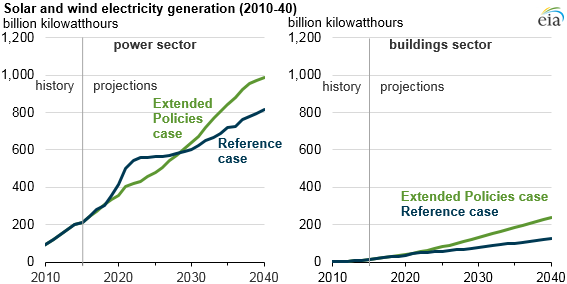
Tax credits and efficiency standards for appliances and vehicles have been key drivers for increasing renewable energy use and energy efficiency in the United States. Extending these policies and increasing the stringency of the Clean Power Plan beyond 2030 would reduce energy-related carbon dioxide (CO2) emissions by reducing motor fuel use and energy use in buildings by increasing efficiency and by increasing the share of solar and wind in the electricity generation mix.
In EIA's Annual Energy Outlook 2016 (AEO2016) Reference case projection, which generally assumes current laws and policies, electricity generation from solar and wind sources across all sectors increases from 227 billion kilowatthours in 2015 to 950 billion kilowatthours in 2040. In the Extended Policies case, which perpetuates policies beyond their legislated expiration, solar and wind generation grow to 1,236 billion kilowatthours in 2040, or 30% above the Reference case level.
Production tax credits for renewable energy are legislated to expire or reduce in value in 2017, and investment tax credits for solar energy begin to decline in 2020. In the residential sector, these credits expire completely at the end of 2021. As these tax credits decline or expire, utilities and distributed generator (e.g., rooftop solar panels) customers accelerate investment and production projects to take advantage of the full value of the credits. In the Reference case, this acceleration results in a period of fast growth in renewable generation up to those expiration dates. In the Extended Policies case, these credits are extended at their current value through 2040, leading to steadier and ultimately larger growth in renewable energy.
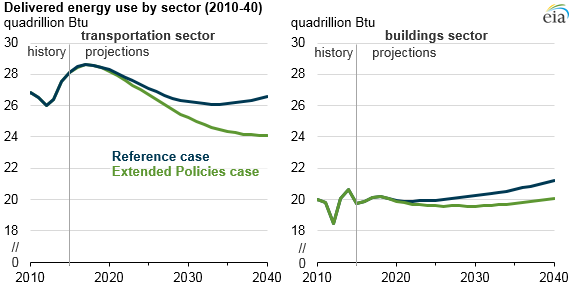
The Extended Policies case also extends federal energy efficiency policies that encourage the adoption of efficient appliances and equipment in the residential, commercial, industrial, and transportation sectors. Reductions in transportation energy use in the Extended Policies case are driven by extension of fuel economy requirements that further decrease energy consumption in light-duty, medium-duty, and heavy-duty vehicles.
Lower energy use and emissions in the buildings sector in the Extended Policies case result from improved energy efficiency of equipment for heating, cooling, and other uses, as well as increased adoption of more stringent building energy codes. Greater use of distributed generation, such as rooftop solar photovoltaic systems, reduces purchases of electricity.
The full Issues in Focus article on the Extended Policies case provides detailed discussions of the assumptions and results.
Principal contributor: David Peterson