
Oil prices drive projected enhanced oil recovery using carbon dioxide
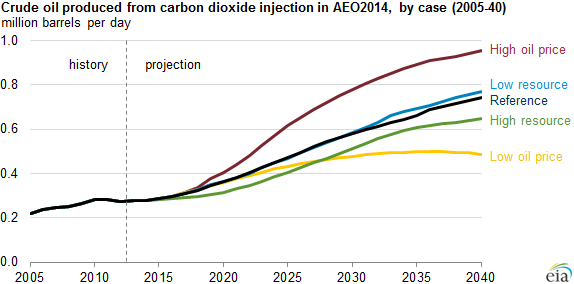
In the 2014 Annual Energy Outlook (AEO2014), EIA projects that the price of oil will largely determine whether to use carbon dioxide (CO2) enhanced oil recovery (EOR) technologies to extract additional crude oil from existing producing fields. The injection of CO2 gas into oil reservoirs at high pressure forces the CO2 to mix with oil. This reduces the oil's viscosity and causes the oil to increase in volume (swell). The result is an increase in the total cumulative volume of oil produced and in the percentage of oil-in-place that is recovered. The decision by a producer whether or not to employ this technique depends on a number of factors, including the geophysical properties of the reservoir, the oil within that reservoir, the cost of applying CO2 EOR, and the revenue received from additional production.
The injection of miscible (capable of being mixed) CO2 into old oil fields to recover more of the oil-in-place is an expensive undertaking. The cost of the CO2 itself can add $20 to $30 per barrel of oil produced. In addition, the producer must pay for surface facilities to separate the CO2 from the production stream and compress it back into the oil reservoir. The producer also incurs a financial cost for the time delay associated with repressurizing old reservoirs. Oil prices thus play an important role in determining whether the additional production resulting from applying CO2 EOR to old fields is sufficient to make this process commercially and economically feasible.
In the AEO2014 High Oil Price case, the West Texas Intermediate (WTI) crude oil price rises to $202 per barrel (2012 dollars) by 2040, 45% more than in the Reference case. This higher oil price increases the number of old fields that can profitably produce oil using CO2 EOR technology. Oil production in this case reaches 960,000 barrels per day by 2040, 30% more than in the Reference case, in which it reaches 740,000 barrels per day. The opposite results occur in the Low Oil Price case, with WTI prices reaching only $73 per barrel by 2040, limiting the incentive for producers to apply CO2 EOR to old fields. CO2 EOR production reaches only 480,000 barrels per day by 2040 (35% less than in the Reference case). In the Reference case, CO2 EOR production accounts for 10% of total U.S. crude oil production, versus 12% in the High Oil Price case, and 8% in the Low Oil Price case.

The High Oil and Gas Resource case projects a CO2 EOR production of 650,000 barrels per day in 2040 (12% lower than in the Reference case). In comparison, CO2 EOR oil production is more profitable in the Low Oil and Gas Resource case, where higher oil prices result in CO2 EOR oil production that reaches 770,000 barrels per day in 2040 (4% higher than in the Reference case).
Principal contributors: Philip Budzik, Dana Van Wagener