
Liquefied natural gas shows potential as a freight locomotive fuel
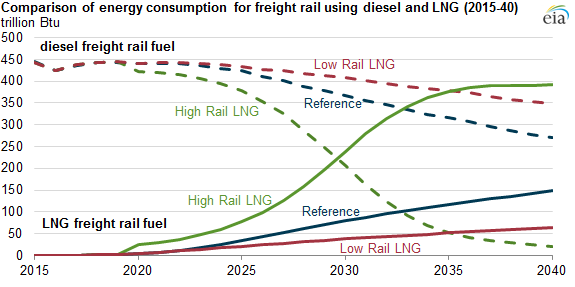
Note: The dotted lines represent diesel fuel use, while the solid lines represent LNG fuel use.
EIA projects that liquefied natural gas (LNG) will play an increasing role in powering freight locomotives in coming years. Continued growth in domestic natural gas production and substantially lower natural gas prices compared to crude oil prices could result in significant cost savings for locomotives that use LNG as a fuel source, according to EIA's Annual Energy Outlook 2014 (AEO2014).
Taken together, the 7 major U.S. freight railroads consumed more than 3.6 billion gallons of diesel fuel in 2012, or 7% of all diesel fuel consumed in the United States. The fuel cost more than $11 billion in 2012 and accounted for 23% of total operating expenses.
These railroads are considering the use of LNG in locomotives because of the potential for significant fuel cost savings and the resulting reductions in fuel operating costs. Given the expected price difference between LNG and diesel fuel, future fuel savings are expected to more than offset the approximately $1 million incremental cost associated with an LNG locomotive and its tender. However, in addition to the risk surrounding future fuel prices, other factors including operational, financial, regulatory, and mechanical challenges also affect fuel choices by railroads.
Some major railroad operators view the potential of LNG-fueled trains as similar to the switch from steam propulsion to diesel in the 1940s and 1950s, a revolution in freight rail known as dieselization. Others have responded with more caution, likening the potential switch to the more evolutionary advance from using direct current (DC) motors to alternating current (AC) motors, which allows fewer locomotives to pull the same load. The change towards AC motors has been ongoing since the early 1990s.
EIA's AEO2014 includes two alternative cases (the High and Low Rail LNG cases) that examine the potential effect of LNG in freight rail. In the Reference case, LNG fuel use increases from just over 1 trillion Btu in 2017 to 148 trillion Btu in 2040, or 35% of total freight rail energy consumption. In the High Rail LNG case, LNG fuel consumption increases to 392 trillion Btu in 2040, or 95% of freight rail energy consumption. LNG consumption in the Low Rail LNG case increases to just 64 trillion Btu, or 16% of total freight energy consumption. Even under the High Rail LNG case, overall demand for natural gas as a result of a switch to LNG would increase overall demand for natural gas by less than 1%, resulting in a minimal effect on natural gas prices.
Additional analysis can be found in the AEO2014 Issues in Focus discussion of potential for liquefied natural gas use as a railroad fuel.
Principal contributor: Nicholas Chase