
U.S. demand for residual fuel oil rose late in 2021
Reposted February 23, 2022 to correct the second chart.
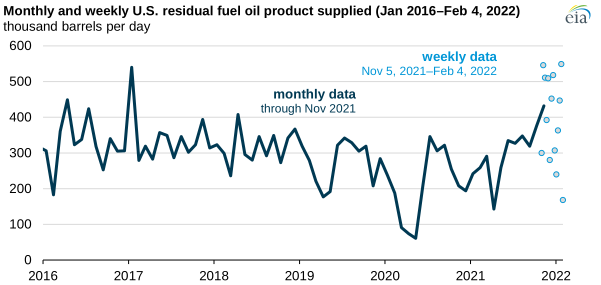
In November 2021, more residual fuel oil was consumed in the United States, measured as product supplied, than during any month since January 2017. Residual fuel oil has several uses, but it is primarily consumed as bunker fuel in the maritime shipping sector. Consumption in December 2021 was at its highest end-of-year level since 2012, according to our Weekly Petroleum Status Report (WPSR).
On January 1, 2020, tighter regulations from the International Maritime Organization (IMO) on maritime fuel sulfur specifications became effective. Before 2020, marine fuel could have a sulfur content as high as 3.5%, which is considered high-sulfur fuel oil. The IMO now requires ships to switch to fuels with a 0.5% sulfur content or less, forcing ships to use a more processed, and more expensive, variety of residual fuel oil called very-low-sulfur fuel oil.
Ships comply with the IMO specification as long as their actual emissions meet the target sulfur emissions level, regardless of the specification of the fuel they use. Ship owners can install sulfur scrubbers on board to reduce sulfur emissions while still consuming high-sulfur fuel oil and remain compliant. Ship scrubbers are expensive and require ongoing maintenance, but vessels can lower operating costs by purchasing high-sulfur fuel oil instead of higher-priced very-low-sulfur fuel oil or low-sulfur marine gas oil.
The IMO regulation applies to global shipping. Marine vessels operating within the North American or U.S. Caribbean Sea Emission Control Areas (ECA) were already required to meet 0.1% sulfur content while operating within those waters.
Since spring 2020, overall production of residual fuel oil has decreased because of substantially less refinery production resulting from the effects of the COVID-19 pandemic.
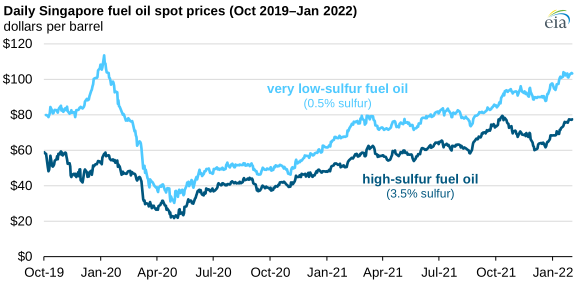
High crude oil prices indirectly contribute to higher overall bunker fuel prices, and higher prices give ship owners stronger incentives to install scrubbers to take advantage of the price discount that 3.5% high-sulfur fuel oil has to 0.5% very-low-sulfur fuel oil.
The increase in residual fuel oil demand comes with record increases in maritime shipping volumes and rising high-sulfur fuel oil prices in Singapore. The Singapore market is a global benchmark for marine shipping. Since the beginning of November 2021, the Singapore very-low-sulfur fuel oil price premium over high-sulfur fuel oil increased to more than $20 per barrel (b) and neared $30/b throughout December 2021 and January 2022.
Note: The high-sulfur fuel oil is 380 centistoke grade.
Principal contributor: Kevin Hack