
Most wind capacity in the United States is designed for a medium wind speed environment
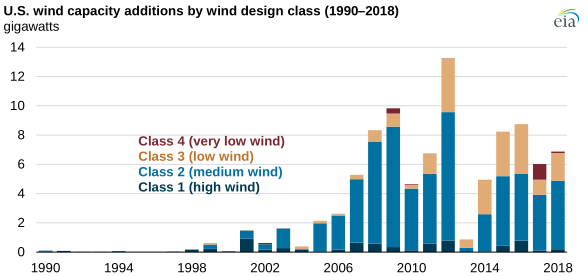
Most wind turbines in the United States were designed for medium wind environments, according to data collected in the U.S. Energy Information Administration’s (EIA) Annual Electric Generator Report. Wind design classes, as defined by the International Electrotechnical Commission (IEC), range from Class 1 (high wind) to Class 4 (very low wind).
Many of the earliest wind projects in the United States were constructed in California using Class 1 turbines. These earlier projects required high wind speeds to generate sufficient wind-powered electricity to offset relatively high installation costs. Technological improvements in wind technology, such as longer blades and higher tower heights, have allowed installation in areas with lower wind resources where it might not have been economically feasible previously.
The IEC defines wind design classes based on the average wind speed, 50-year extreme gust, and turbulence. Wind speeds are measured at the height of the hub, or the center of the circle swept by the turbine blades. Wind speeds generally increase with height, so taller turbines can usually access better wind resources than shorter turbines at the same site.
Class 1 turbines are designed for average wind speeds of 10 meters per second (m/s), or about 22.4 miles per hour (mph), and extreme wind gusts of 156 mph. Class 4 turbines are designed for very low speeds, averaging 6 m/s (13.4 mph), and gusts of 94 mph. Classes 1 through 3 are further divided based on turbulence, or how much the wind typically varies within a 10-minute period.
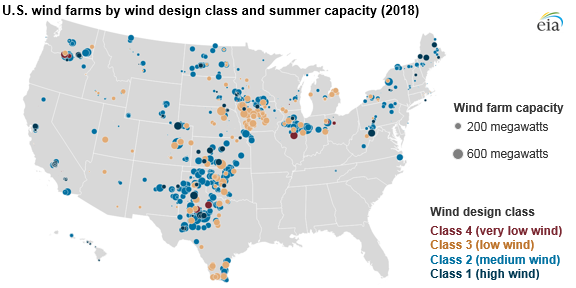
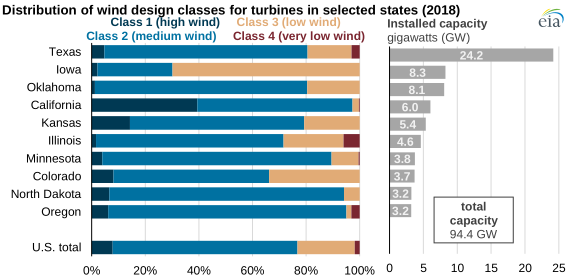
As of the end of 2018, the United States had a total installed wind generating capacity of 94 gigawatts. Four states—Texas, Oklahoma, Iowa, and Kansas—accounted for more than half of the electricity generation from wind turbines in 2018. California has more wind capacity than Kansas—and more turbines than Kansas and Oklahoma combined—but generates less electricity from wind than those states because California’s wind turbines tend to be older and shorter.
Texas has more than one-quarter of the country’s wind capacity, and 80% of Texas’s turbines are in either Class 1 or Class 2 environments. By comparison, only 30% of Iowa’s turbines are in Class 1 or Class 2 environments.
Principal contributor: Manussawee Sukunta