
Soybean oil comprises a larger share of domestic biodiesel production
Note: Marketing years for soybeans run from October 1 through September 30.
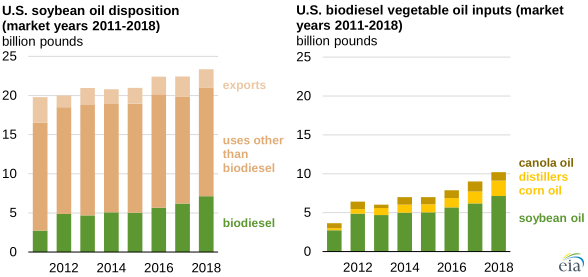
Biodiesel production accounts for an increasing share of soybean oil use in the United States, currently representing about 30% of domestic soybean oil disposition. Soybean oil is the most commonly used vegetable oil for biodiesel production, and inputs reached 7.1 billion pounds during the latest soybean oil marketing year (MY), which ran from October 1, 2017, to September 30, 2018. Growth in biodiesel production has coincided with federal biofuel mandates and other conditions that encouraged a larger share of the domestic soybean oil supply to be consumed as biofuel feedstock.
Biodiesel is a mixture of chemical compounds known as alkyl esters produced from a variety of vegetable oils, fats, and greases. Vegetable oils comprise about three-fourths of total biodiesel feedstock in the United States, with soybean oil accounting for slightly more than half of total inputs by weight. Smaller amounts of vegetable oil for biodiesel production include distiller’s corn oil (an inedible oil that is produced as a byproduct of the corn ethanol production process) and canola oil. Soybean oil and distiller’s corn oil are widely used because the feedstocks are produced in the Midwest, where most biofuel production capacity exists.
About half of U.S. raw soybeans are exported, and much of the rest is processed, or crushed, at soybean processing plants in the United States. The soybean crush yields about 80% soybean meal and 20% soybean oil, which may be further processed into various food and non-food products.
As total U.S. soybean oil supply grew between MY 2010–2011 and MY 2017–2018, from about 22.5 billion pounds to nearly 26.0 billion pounds, the share of total soybean oil consumed as a biodiesel feedstock doubled, from about 15% to 30%. Soybean oil and other vegetable oils may also be used as a feedstock for renewable diesel, a separate biofuel that is increasingly produced at stand-alone facilities and petroleum refineries.
Between MY 2010–2011 and MY 2017–2018, domestic biodiesel production grew from 0.7 billion gallons to 1.8 billion gallons. The increase in production has largely been driven by the Renewable Fuel Standard (RFS), a program administered by the U.S. Environmental Protection Agency that mandates the blending of renewable fuels into the nation’s fuel supply. The RFS target for biomass-based diesel, which collectively refers to biodiesel and renewable diesel, grew from 1.15 billion gallons to 2.10 billion gallons between compliance years 2010 and 2018.
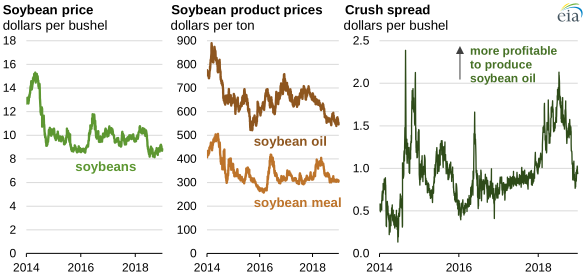
Soybean crush margins—the difference between the value of raw soybeans and the value of soybean meal and soybean oil—were at near record-high levels around the time China imposed a 25% tariff on U.S. soybeans (effective July 6, 2018). Periods of high crush margins are associated with higher profits for soybean processors and, therefore, tend to increase the total soybean oil supply. Elevated crush margins during 2018 corresponded with record-high monthly soybean oil inputs for biodiesel production.
Principal contributor: Steve Hanson