Energy needed to produce aluminum
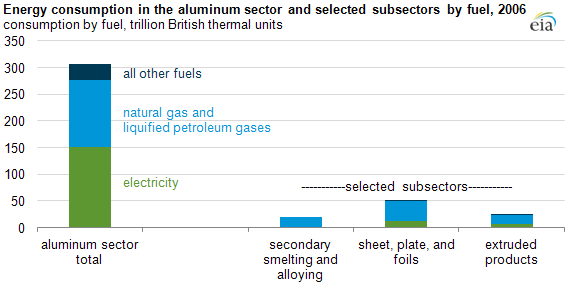
Note: Extruded aluminum products are formed by forcing aluminum out of a die to form a shape rather than using a mold.
Aluminum production in the United States generally takes two forms, with very different energy requirements. Primary production involves making aluminum products from raw material or ingots, which is highly energy intensive, especially electricity intensive. Secondary production involves recycling aluminum scrap to form new products, a significantly less energy-intensive process. Aircraft use primary aluminum because of quality and consistency restrictions, while beverage cans and automotive castings often use secondary aluminum.
The figure above shows energy consumption for the entire aluminum sector, which includes all primary, secondary, and downstream production. Total aluminum sector energy use accounted for over 300 trillion British thermal units in 2006. Primary processing includes processing raw materials and manufacturing aluminum. The subsector secondary processing includes melting scrap. The other two subsectors are downstream products that can be made either from primary or secondary aluminum.
Primary production starts with bauxite ore, which, in the United States, is usually imported from Jamaica and South America. Bauxite is then converted into aluminum oxide, or alumina, using natural gas at plants located in the southern United States. After alumina is extracted from bauxite ore, further processing called 'smelting' is necessary to convert it into aluminum. In this process, alumina is dissolved in a solution and a strong electric current is applied. This process has generally remained unchanged since its invention in 1886.
Because smelting requires significant amounts of electricity, some primary aluminum smelters can be found in areas with lower-cost electricity, often in areas with rich hydroelectric resources, such as the Pacific Northwest and Upstate New York. However, other smelting plants can be found in the Midwest, Appalachia, and Texas. New primary aluminum smelters are not expected to be built in the United States, although existing ones are expected to increase capacity utilization or expand production capability.
Secondary production is aluminum produced from aluminum scrap. Beverage cans and aluminum automotive parts, such as engine blocks, are two of the most common types of items made from secondary aluminum. Aluminum building materials are also recycled. Producing secondary aluminum involves cleaning and separating aluminum scrap from other materials and melting it down in a furnace, usually fired by natural gas. Compared to the energy requirements of primary production, secondary production is much less energy intensive.
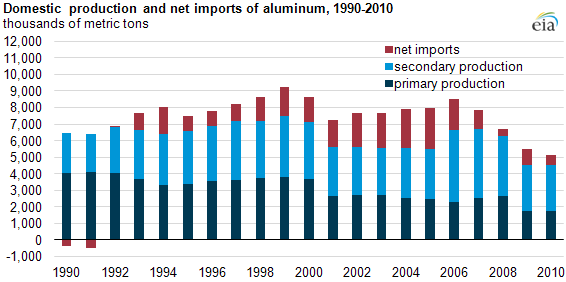
The figure below shows average annual U.S. aluminum production and net imports of finished aluminum. Production fluctuates considerably to meet U.S. aluminum demand, which changes with economic conditions. The United States has been a net importer of aluminum since 1992. For domestic production, the share of primary production has steadily declined while secondary production has generally remained steady. The low figures in production and net imports reflect the recession and slow recovery.