
EIA tool compares individual power plants’ generation, cooling water use, and emissions
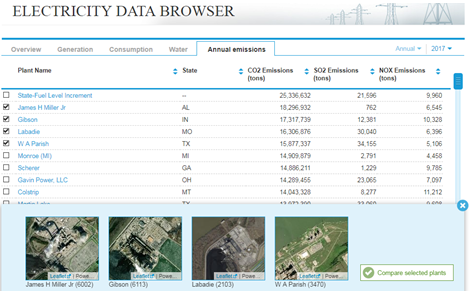
EIA’s electric power sector surveys collect plant-level information on several attributes of U.S. power plants, including cooling water use and emissions data. EIA has made enhancements to the Electricity Data Browser to simplify access to information about plant-level cooling water use and estimates of emissions of nitrogen oxides (NOx), sulfur dioxide (SO2), and carbon dioxide (CO2). These data are now available on the beta version of the Electricity Data Browser.
The browser now includes annual plant-level CO2, SO2, and NOx emissions estimates for power plants that burn combustible fuels. For example, Florida Power and Light’s West County Energy Center, located near Juno Beach, Florida, is one of the largest fossil-fueled generators of electricity in the United States. In 2017, the West County Energy Center generated 20.5 million megawatthours (MWh) of electricity, as well as 7.7 million tons of CO2, 37 tons of SO2, and 485 tons of NOx.
EIA collects cooling water data for plants with a combustible-fueled thermoelectric generating capacity of 100 megawatts (MW) or more. Thermoelectric power plants include units fueled by natural gas, coal, nuclear, and oil, as well as renewable sources, such as biomass and solar thermal plants, which also require cooling. In 2017, 63% of all U.S. electricity generation was produced by thermoelectric units (excluding geothermal units), 54% of which had a capacity of 100 MW or more.
Thermoelectric power plants generate electricity by heating water to high temperatures to produce steam, which is then passed through a turbine to generate electricity. Once the steam has passed through the turbine, it must be cooled so it can condense back to a liquid and be returned to the boiler or steam generator. Of the three main types of cooling systems currently in use, two (once-through systems and recirculating systems) require cooling water.
The updated browser provides water withdrawal, discharge, consumption, and water-use intensity information for all cooling systems at each reporting plant. For example, the Browns Ferry Nuclear Plant near Athens, Alabama, one of the largest nuclear power plants in the United States, generated 27.8 million MWh of electricity in 2017 and withdrew more than one million gallons of water from the nearby Tennessee River to use in its cooling system. According to the Tennessee Valley Authority, the federal public power corporation that operates the Browns Ferry plant, about 99% of the water withdrawn from the river is discharged back into it.
The updated browser also allows users to generate side-by-side comparisons of the location, generation, energy consumption, and water usage of different plants, or of the water usage by the cooling systems within a plant. Monthly, quarterly, and annual data are available for 2014 through 2017; EIA expects to publish preliminary 2018 data in June 2019.
Principal contributor: Sara Hoff
Tags: emissions, power plants, electricity, generation