
Beyond China, other Southeast Asian countries plan for significant hydroelectric additions
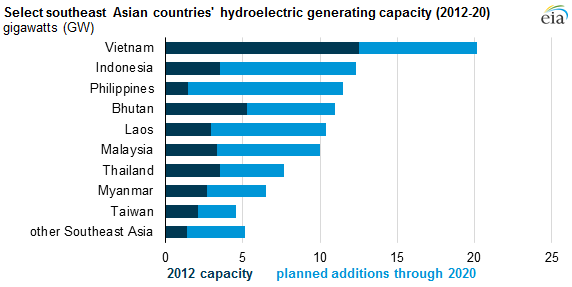
Note: Other Southeast Asia includes Bangladesh, Cambodia, Nepal, Papua New Guinea, and Singapore.
China's substantial development of hydroelectric power, including the largest power plant in the world at Three Gorges Dam, has overshadowed the relatively large hydroelectric expansion plans of other Southeast Asia countries. Combined, the smaller countries of Southeast Asia plan to construct 61 gigawatts (GW) of new hydroelectric generating capacity through 2020. If all planned projects are completed, these countries will more than double their 2012 hydroelectric capacity of 39 GW.
Many countries in Southeast Asia are planning to access the immense hydroelectric potential of the lower Mekong River, which flows through or borders China, Myanmar, Laos, Thailand, Cambodia, and Vietnam. China has constructed six major dams along the upper portion of the Mekong River. Hydroelectric power potential in the Greater Mekong Region (which includes Mekong tributaries) is estimated between 175 GW and 250 GW. As of 2010, 71 Mekong hydroelectric dams were proposed for completion by 2030.
Vietnam, Indonesia, Bhutan, and Laos are four of the many Southeast Asian countries with significant planned hydroelectric additions, from projects in the Mekong region as well as projects centered on other hydroelectric resources.
Vietnam has the most ambitious hydroelectric development plan in Southeast Asia, with plans to develop 205 hydroelectric projects (6.2 GW) by 2017, and nearly 4 gigawatts (GW) of additional capacity between 2017 and 2030. One of the largest projects, Trung Son, a 360-megawatt (MW) project, is located on the Ma River in northern Vietnam, which is not a Mekong tributary.
Indonesia's goal is to develop 5.7 GW of new hydroelectric generating capacity by 2021. Included is one of the larger hydroelectric projects outside of China, the 1,040 MW Upper Cisokan pumped storage power facility projected to be in service by the end of 2018.
Bhutan, a relatively small, mountainous country surrounded by India and China, plans to build 10 GW of hydroelectric generating capacity. Because much of this electricity will be exported to India, India is funding these projects. Many of Bhutan's rivers feature high vertical drops over a short distance, ideal for hydroelectric generation. Three of these facilities with a combined 2,940 MW capacity are currently under construction.
Laos, which currently has hydroelectric generating capacity of about 2.5 GW, plans to increase that capacity to more than 9 GW by 2020. This increase includes 17 projects currently in the planning stage with a combined capacity of more than 4.5 GW. One-fourth of this capacity is attributed to the 1,285 MW Xayaburi hydroelectric power plant, the first of 11 planned hydroelectric generating plants along the lower Mekong River. Laos, like Bhutan, expects to be a major electricity exporter.
Despite the strong electrification potential of these projects, there are major concerns about the environmental impacts of damming the Mekong River system and other rivers in Southeast Asia. An independent assessment prepared for the Mekong River Commission recommended a 10-year delay in the current hydroelectric project schedule to evaluate environmental concerns.
Principal contributor: Fred Mayes