
Minimum efficiency standards for electric motors will soon increase
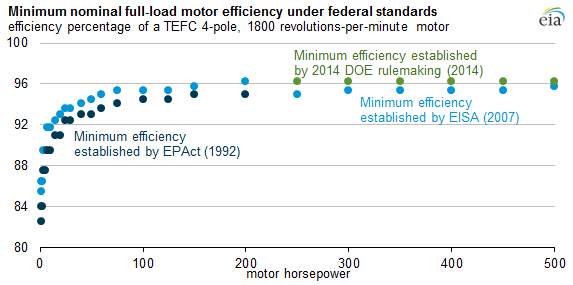
Note: TEFC is a totally enclosed, fan-cooled motor. EISA is the Energy Independence and Security Act of 2007. EPAct is the Energy Policy Act of 1992.
Nearly half of the electricity consumed in the manufacturing sector is used for powering motors, such as for fans, pumps, conveyors, and compressors. About two thirds of this machine-drive consumption occurs in the bulk chemicals, food, petroleum and coal products, primary metals, and paper industries. For more than three decades the efficiency of new motors has been regulated by federal law. Beginning in mid-2016, an updated standard established this year by the U.S. Department of Energy (DOE) for electric motors will once again increase the minimum efficiency of new motors.
The updated electric motor standards apply the standards currently in place to a wider scope of electric motors, generating significant estimated energy savings. DOE's analyses estimate lifetime savings for electric motors purchased over the 30-year period that begins in the year of compliance with new and amended standards (2016-45) to be 7.0 quadrillion British thermal units (Btu). The annualized energy savings—0.23 quadrillion Btu—is equivalent to 1% of total U.S. industrial primary electricity consumption in 2013.
Legislation has increased the federal minimum motor efficiencies requirements over the past two decades, covering motors both manufactured and imported for sale in the United States. The Energy Policy Act of 1992 (EPAct) set minimum efficiency levels for all motors up to 200 horsepower (hp) purchased after October 1997. The U.S. Energy Independence and Security Act (EISA) of 2007 updated the EPAct standards starting December 2010, including 201-500 hp motors. EISA assigns minimum, nominal, full-load efficiency ratings according to motor subtype and size. The Energy Policy and Conservation Act of 1975 also requires DOE to establish the most stringent standards that are both technologically feasible and economically justifiable, and to periodically update these standards as technology and economics evolve.
Motors typically fail every 5 to 15 years, depending on the size of the motor. When they fail they can either be replaced or repaired (rewound). When motors are rewound, their efficiencies typically diminish by a small amount. Large motors tend to be more efficient than small motors, and they tend to be used for more hours during the year. MotorMaster+ and MotorMaster+ International, distributed by the U.S. Department of Energy and developed by the Washington State University Cooperative Extension Energy Program in conjunction with the Bonneville Power Administration, are sources for cost and performance data on replacing and rewinding motors.
Improving the efficiency of motor systems, rather than just improving the efficiency of individual motors, may hold greater potential for savings in machine-drive electricity consumption. Analysis from the U.S. Department of Energy shows that more than 70% of the total potential motor system energy savings is estimated to be available through system improvements by reducing system load requirements, reducing or controlling motor speed, matching component sizes to the load, upgrading component efficiency, implementing better maintenance practices, and downsizing the motor when possible.
Principal contributors: Mark Schipper, Kelly Perl
Tags: efficiency, electricity, manufacturing