
U.S. could become the world’s top liquid fuels producer, but how much does it matter?
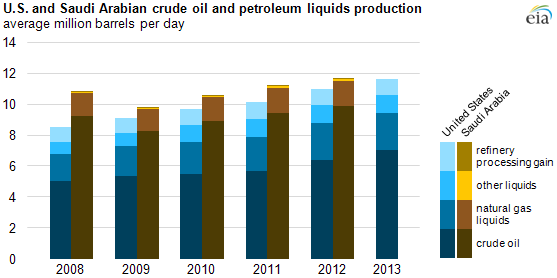
Note: Crude oil includes lease condensate. Volumes for 2012 and 2013 are projected.
Download CSV Data
Significant increases in U.S. production of crude oil and other liquid fuels and the outlook for further growth have focused attention on the possibility that the United States could soon surpass Saudi Arabia to become the leading global producer.
A higher level of U.S. oil production could significantly boost the U.S. economy, and could also reduce global oil prices through its effect on the global crude oil and product market balances. However, regardless of any future crossing of U.S. and Saudi production paths, the timing of which would depend on which particular accounting convention is applied, Saudi Arabia will continue to play a unique and vital role in world oil markets.
U.S. production growth is only one of several key factors that determine when, or even if, such a milestone might be reached. Saudi Arabia, a leading member of the Organization of the Petroleum Exporting Countries (OPEC), plays a unique role as the only oil producer with significant spare production capacity. Saudi Arabia operates as the world's main swing producer to balance the global market in response to supply or demand changes.
Because nearly all other OPEC and non-OPEC producers operate at their effective capacity, Saudi production levels can move significantly in response to economic fluctuations affecting global oil demand, changes in non-OPEC production capacity outside the United States, and changes in production capacity of OPEC members other than Saudi Arabia. A more detailed discussion of these drivers and their impacts is presented in the December 19 edition of This Week In Petroleum.
In addition to these factors, which together drive the large uncertainty in the future path of Saudi production, the choice of accounting conventions for measuring liquids production also affects which country is considered the world's leading producer at a given date. Using the broadest definition of liquids production (encompassing crude oil, condensate, natural gas liquids, biofuels, and refinery gain), the difference between U.S. and Saudi production is currently estimated by the U.S. Energy Information Administration (EIA) to be 0.6 million barrels per day (bbl/d), considerably smaller than the gap of 3.5 million bbl/d when the comparison is restricted to crude oil production only. Clearly, any prediction of a crossing in U.S. and Saudi production paths is highly dependent on many difficult-to-forecast drivers that primarily impact the level of Saudi production. For this reason alone, one simply cannot attach high confidence to any forecast that suggests the specific timing of any future crossings or re-crossings. And, as already noted, any declaration of whether a crossing has occurred will inevitably also reflect accounting conventions even after production data are already in hand.
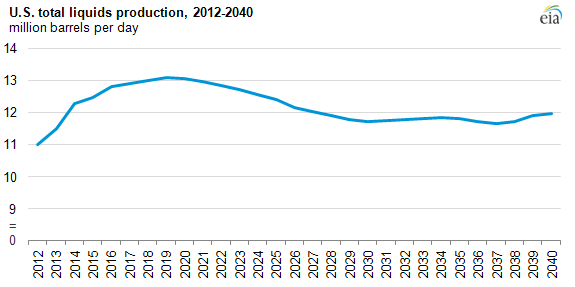
EIA's December 2012 Short-Term Energy Outlook (STEO) projected that U.S. crude oil and liquid fuels production (comprising crude oil, natural gas liquids, renewables and oxygenates, and refinery processing gain) will average 11.0 million bbl/d in 2012, an increase of 870,000 bbl/d (9%) over 2011. Since 2008, domestic crude oil and liquid fuels production has risen by 2.4 million bbl/d (28%). For 2013, STEO projected that U.S. crude oil and liquid fuels production will increase further, averaging 11.7 million bbl/d. Looking further ahead, EIA's Annual Energy Outlook 2013 Early Release (AEO) Reference case projected U.S. liquid fuels production to increase steadily for the next several years, peaking at about 13.0 million bbl/d in the 2018-to-2020 period. Liquid fuels production in Saudi Arabia, the world's leading producer over much of the past decade, averaged 11.2 million bbl/d in 2011 and 11.6 million bbl/d during the first half of 2012, while maintaining substantial spare capacity.