
Large hospitals tend to be energy-intensive
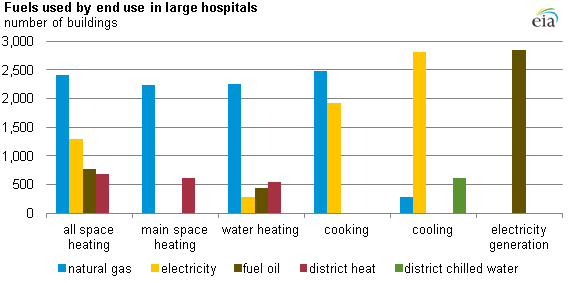
Note: Within a building, more than one fuel may be used for a given end use.
Large hospitals consumed 458 trillion British thermal units, about 5.5% of the total delivered energy used by the commercial sector in 2007, a much larger share than their percentage of total commercial floorspace. EIA recently released data from the 2007 Commercial Buildings Energy Consumption Survey (CBECS) that highlights large hospitals' energy-related characteristics for all major fuels: electricity, natural gas, fuel oil, and district heat.
Large hospitals are those over 200,000 square feet. In 2007, there were approximately 3,040 large hospital buildings in the United States, with an average of 640,000 square feet per building.
Based on data from past CBECS, hospitals tend to consume more energy per square foot than other buildings in the commercial sector, such as offices, retail stores, or educational buildings. They are open 24 hours a day; occupied by thousands of employees, patients, and visitors; and often employ sophisticated heating, ventilation, and air conditioning (HVAC) systems to control temperatures and air flow.
In addition, many energy-intensive activities occur in these buildings: laundry, medical and lab equipment use, sterilization, computer and server use, food service, and refrigeration. Not surprisingly, most of these energy-intensive buildings had energy management and conservation plans in place, and used technology and products to save energy.
As shown in the graph above, natural gas was the most common main space heating fuel, used by 74% of the buildings, followed by district heat, or steam or hot water from an outside source, which was the main heating source for 20% of large hospitals. All hospital buildings had cooling (air conditioning) and almost all, 92%, used electricity to power cooling equipment.
Water heating was also used in all hospital buildings and had fuel-use percentages similar to space heating: 74% natural gas and 19% district heat. Cooking was reported in 95% of the hospital buildings, with natural gas and electricity the most common cooking fuels. Because of their need for a secure reliable source of electricity, almost all large hospitals (95%) used energy for generating electricity, primarily for emergency back-up generation. Fuel oil was by far the most common fuel used for this purpose.
For the first time in its 30-year history, the CBECS also collected data on water use. Large hospital buildings in the United States consumed an estimated 133 billion gallons of water in 2007, totaling $615 million in water expenditures, with an average of 43.6 million gallons and $202,200 per building.